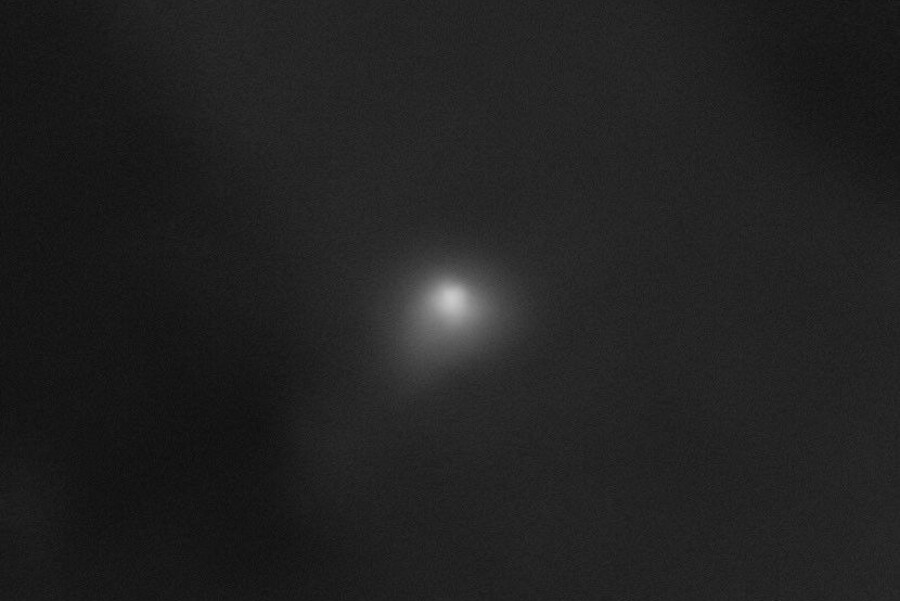
NASA published on Wednesday the first images of the comet 3I/ATLAS, the third interstellar body known to have passed through our solar system, and its study will allow scientists to increase their knowledge of the composition of other systems.
The closest images of the comet were taken in October by the HiRISE camera on NASA's Mars orbiter when the celestial body approached the red planet at a distance of 30 million kilometers, according to the U.S. government agency. The images show a faint smudge on a black background corresponding to the comet.
Thanks to the instruments of space missions on Mars, NASA was able to observe the comet in more detail. Telescopes of all kinds participated in its observation, including Hubble and James Webb, two of the most powerful ones NASA has.
Comet 3I/ATLAS is the third interstellar body that scientists have been able to detect. Two other photographs captured by NASA's Perseverance rover on Mars show the comet very diffusely advancing among the stars.
"It came from an environment different from ours, and we are already appreciating very interesting differences compared to the comets in our solar system," said NASA's associate administrator, Nicky Fox, at a press conference.
She added that the comet was not a danger to Earth, as it passed at twice the distance that separates our planet from the Sun. However, Fox said that its observation from Earth was complicated, as when it passed its closest point to the Sun, the planet was on the opposite side.
The first was the comet 1I/Oumuamua, in 2017, followed by 2I/Borisov, in 2019. Fox added that this type of discovery is becoming more and more common due to the development of new technologies that allow its identification.
3I/ATLAS was discovered on July 1 by the ATLAS telescope located in Río Hurtado, in Chile. It was initially expected to be too faint to be observed, but according to NASA its brightness increased enough to become visible.