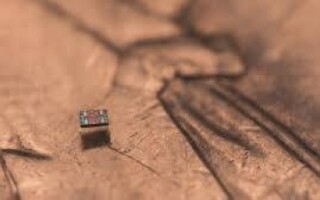
Scientists from the Universities of Pennsylvania and Michigan have invented a robot smaller than a millimeter, equipped with its own computer, motor, and sensors. Although nanomachines still represent a distant future, this robot, smaller than a grain of salt, is a revolutionary step toward that goal, according to the American newspaper 'The Washington Post'. 'This is the first small robot that can sense, think, and act,' said Mark Miskin, an assistant professor of electrical and systems engineering at the University of Pennsylvania and one of the study's authors. Although the device is still in the experimental stage, co-author David Blei from the University of Michigan said, 'I would not be surprised if we have practical applications for this type of robot within 10 years.' The robot resembles a tiny electronic chip and is made of materials similar to silicon, platinum, and titanium. It is protected by a layer of glass to enable it to operate in fluids. It uses solar cells to power its built-in computer and propulsion system. While the robot's computer is much slower than modern laptops, it is powerful enough to respond to changes in its environment, such as temperature. 'At this level, the robot's size and power budget are comparable to many single-celled microorganisms,' the team wrote in the study. One of the robot's key features is its ability to communicate with human operators. Miskin explained, 'We can send it messages telling it what we want it to do, and it can send us messages to tell us what it saw and what it did.' According to the American newspaper, the next major challenge is to establish communication between the microrobots themselves. The robot moves by swimming, using a pair of electrodes to create a current in the water molecules around it.