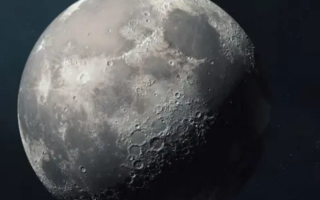
A recent scientific study has revealed that the Moon is still gradually shrinking, leaving behind an increasingly complex network of cracks that could have significant implications for future exploration plans. Scientists from the National Air and Space Museum's Center for Earth and Planetary Studies have discovered over a thousand previously unknown cracks on the lunar surface, which reinforces evidence that the Moon continues to shrink and reshape its geological structure. Researchers believe this phenomenon is caused by the cooling of the Moon's interior over time, leading to its gradual contraction and the shrinking of its crust, according to a report by the British newspaper 'Daily Mail'. Since 2010, scientists had been observing the formation of unique geological features known as 'lobate scarps' in the lunar highlands. These form when the crust compresses, causing rock blocks to thrust over one another along faults, creating high cliffs. However, the novelty of this study is the detection of similar cracks in the lunar 'maria'—the large, dark, smooth plains on the Moon's surface. The researchers have named these features 'small mare ridges' (SMRs). The lead researcher of the study, Tom Watters, who first discovered these cracks in 2010, noted that the new findings complete the global picture of a dynamic Moon that is still in a state of change. Despite the scientific importance of the discovery, the researchers warn that the proliferation of these scarps could pose a risk to the infrastructure of any long-term human presence on the Moon, due to the potential for shallow moonquakes that could affect structures and equipment. These warnings take on particular significance in light of NASA's plans to return astronauts to the lunar surface by 2028 as part of the 'Artemis 3' mission, making the understanding of lunar seismic activity as much a safety issue as a scientific one.