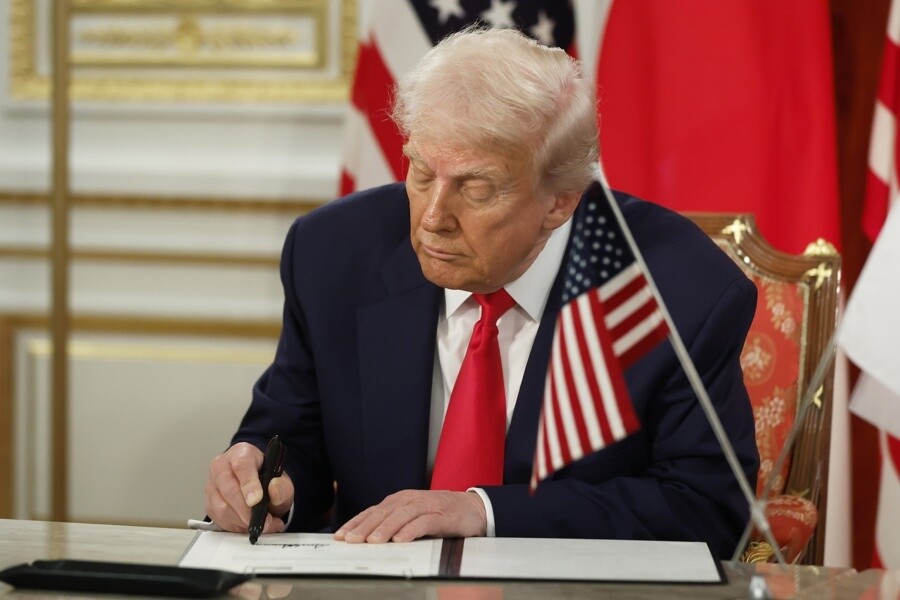
United States President Donald Trump has signed several agreements with Asian and Oceanian countries in recent days to increase Washington's access and joint investments in the rare earth sector, a production that Beijing almost monopolizes. This issue is expected to be a key topic in his talks with his Chinese counterpart, Xi Jinping, this Thursday.
Trump, who arrived in South Korea today where he will meet Xi on Thursday for their first face-to-face since he returned to the White House, has announced several pacts, with few details and whose real weight is questioned by experts, throughout his Asian tour, the first of his second term.
Diversifying access to rare earths is key to the American's agenda, as China controls over 70% of global production and almost 90% of the processing of these minerals, essential for the electric vehicle, wind turbine, and semiconductor industries, among others.
**Japan**
Yesterday in Tokyo, the second stop on his tour, Trump signed a collaboration agreement with Japan's new Prime Minister, the conservative Sanae Takaichi, to boost investments in the rare earth sector, with no specific information on potential projects.
The two countries agreed on a six-month deadline to «provide financial support to selected projects, with the aim of generating a final product for delivery to buyers in the United States, Japan, and like-minded countries,» according to a White House communiqué.
The projects, the text says, will not be limited to the processing of raw materials but will also include derivative products such as permanent magnets, batteries, catalysts, and optical materials.
**Thailand and Malaysia**
In Kuala Lumpur, the first stop of the trip where Trump arrived on Sunday to participate in the ASEAN summit, the Republican closed agreements with Thailand and Malaysia on rare earths to «enhance the strength, security, and prosperity of supply chains».
According to the US, Bangkok will support the transition of critical minerals and rare earths to open, efficient, secure, and transparent markets, while committing with Washington to «deter the sale» of these elements «for national security reasons» when it deems it necessary.
Trump also signed an agreement with Malaysia on Sunday, in which the Asian country commits «not to ban or impose quotas on the export of critical minerals or rare earths to the United States,» according to the White House.
The pact will allow the granting of licenses to American companies to boost the development of the sector in the Asian country.
**Australia**
Just before embarking on the trip to Asia, Trump received Australian Prime Minister Anthony Albanese at the White House, with whom he also signed an agreement on rare earths, which aims to consolidate the United States' access to Australian strategic minerals.
The Australian country, which has the world's fourth-largest rare earth deposits (behind China, India, and Brazil), signed the agreement with the US, which Trump had previously shown reluctance towards.
«The one with Japan is for research collaboration,» and «the other two are insignificant,» the report adds.
Rare earths are expected to be one of the key topics in the talks between Trump and Xi on Thursday, after Beijing announced new controls on its exports at the beginning of the month and Washington threatened to impose 100% tariffs on China in return starting November 1.
According to experts, Australia is home to the only producer of heavy rare earths outside of China, through the company Lynas Rare Earths, and aspires to develop its processing and transformation capacity, a goal that will face environmental and technical regulations that could slow its development.
«The only important one is the (agreement) with Australia,» Alicia García Herrero, chief economist for Asia-Pacific at Natixis, told EFE, adding that Canberra signed the agreement in exchange for the preservation of the AUKUS security pact (by its English acronym for Australia, UK, and the US).