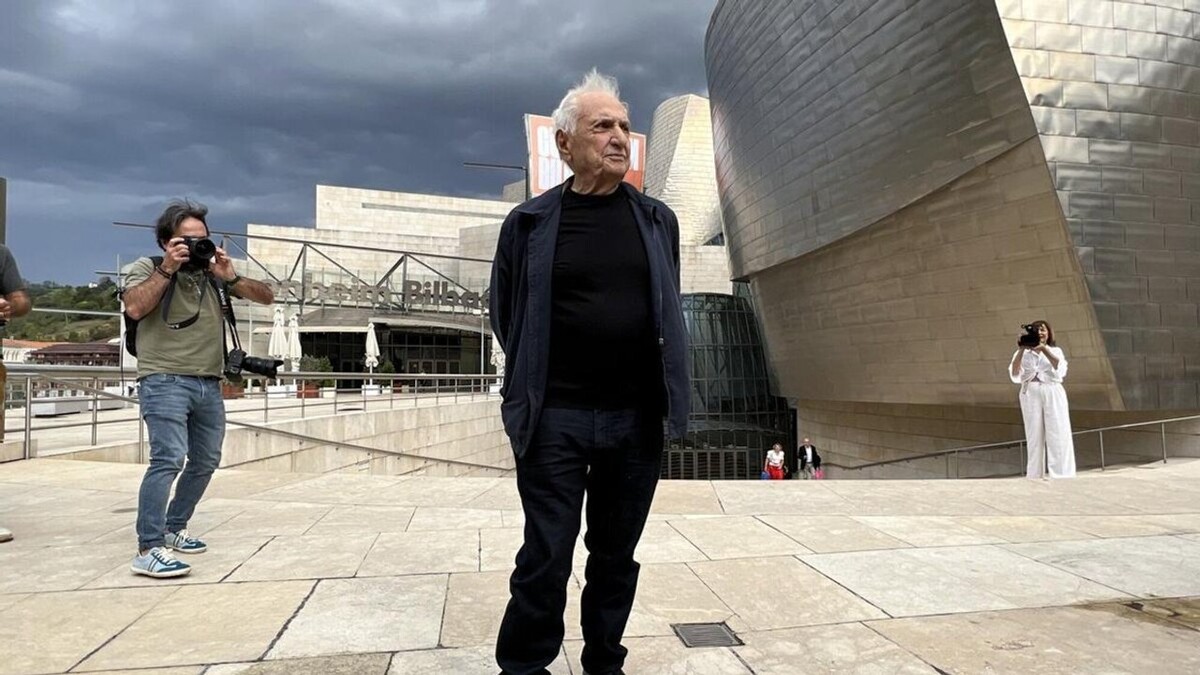
Canadian-American architect Frank Gehry, one of the great renovators of contemporary architecture and author of icons such as the Guggenheim Bilbao and the Walt Disney Concert Hall, died at the age of 96 at his home in Santa Monica, California. For this work, he received awards such as the Friedrich Kiesler Foundation Award (1998) and the International Design Award (1999) from the North American Society of Lighting Engineers.
In Spain, he also left his mark with the Barcelona Olympic sculpture — the famous "fish" next to the Hotel Arts —, the remodeling of the Marqués de Riscal wineries in Álava, and the design of the futuristic skyscraper in the Sant Andreu-Sagrera area.
Frank Gehry's death marks the departure of an essential figure who redefined the relationship between art, architecture, and the city.
Returning to Los Angeles in 1962, he opened his own studio and progressively developed the style that would make him world-renowned. Linked to the American deconstructivist movement, Gehry promoted an architecture of fragmented and dynamic volumes, in which the building is conceived as a work of art. Iconic works such as the Guggenheim Bilbao, the Jay Pritzker Pavilion in Chicago, or the Walt Disney Concert Hall in Los Angeles cemented his status as an international reference.
Throughout his extensive career, he received the highest honors in the discipline, including the Pritzker Prize in 1989 and the Japan Imperial Prize in 1992. He also designed the Museum of the History of Polish Jews in Warsaw and the Biomuseo in Panama.
The Guggenheim in Bilbao, an international emblem
The building that definitively catapulted him to global fame was the Guggenheim Bilbao Museum (1991-1997), whose bold combination of titanium, glass, steel, and stone transformed the image of the Basque city and became a symbol of contemporary urban planning.
Considered a pioneer who expanded the limits of design and engineering, his work left an indelible mark on the global cultural landscape. Creator of a deeply personal architectural language, characterized by the use of bold curves, unconventional materials, and a particular attention to dialogue with the urban environment, Gehry decisively transformed the architecture of the late 20th and early 21st centuries.
In 1947, he moved with his family to California, where he studied Architecture at the University of Southern California and later Urban Planning at Harvard's Graduate School of Design after completing his military service. He began his professional career in firms such as Victor Gruen Associates and Pereira & Luckman Associates. In 1961, he settled in Paris, where he worked with André Remondet and studied the work of Le Corbusier and other European masters who would influence his early work.
His legacy will continue to live on in the cities he transformed and in generations of architects who found in him a master of form and imagination.
His interest in innovative materials led him to create lines of cardboard furniture — Easy Edges and Experimental Edges — and the famous Fish Lamps, as well as designs such as the Bent Wood collection.
Among his most outstanding works are his house in Santa Monica, the Cabrillo Marine Museum and the Los Angeles Air Museum, Loyola Law School, the University of Minnesota Museum, the American Center in Paris, the Vitra building in Basel, and the Experience Music Project in Seattle.
His firm, Gehry Partners LLP, based in Los Angeles, continues to develop projects under his conceptual line.
A deconstructivist architect
Born in Toronto on February 28, 1929, as Frank Owen Goldberg, son of Jewish immigrants of Russian and Polish origin, he adopted the surname Gehry in 1954.