Despite her short life, British writer Jane Austen (1775-1817) left behind an enduring legacy that the Grolier Club, a society of bibliophiles in New York, will explore in detail until February. Hidden in a corner of the Upper East Side in Manhattan, the Grolier Club is exhibiting until Valentine's Day more than 100 books, posters, letters, and essays related to Austen, who would be 250 years old today. The exhibition is divided into five 50-year periods, in which the public delves into the intricacies of Austen's literature and how she was perceived by her passionate fans. In this way, 'Paper Jane: 250 Years of Austen' functions like a kaleidoscope, a device in which, by turning it, a different thing is observed each time. 'We try to show the most important aspects of Jane Austen at each moment and how her readers perceived her,' explains EFE Mary Crawford, one of the exhibition's curators, who shares her name and surname with the popular character from 'Mansfield Park', a novel by the author.
A love letter to Jane born from private collections
The exhibition also serves as a love letter to Austen written by the curators, as the objects on display behind glass and on shelves belong to their own collections. It turns out that Crawford, Sandra Clark, and Janine Barchas, all members of the Grolier Club, have been acquiring all kinds of Austen artifacts for at least four decades, sometimes purchasing them in the most unexpected places. Such is the case of a first American edition of 'Pride and Prejudice', a 'pirated' book that copied the third edition of the work released in London and which is also the most valuable object in the exhibition. Clark tells EFE that she spent years chasing this item, an apparently impossible search that ended when she found it on Amazon, as the original owners had left it in their house and, after selling the house, the new buyers decided to put it up for sale. For Crawford, one of the pieces that resisted her the most was the second edition of 'Sense and Sensibility', which she finally found by surprise on the floor of a bookstore in Tempe (Arizona): 'Nobody knew what it was,' she recounts with laughter.
Jane Austen: from being read in the trenches to being marketed as 'for girls'
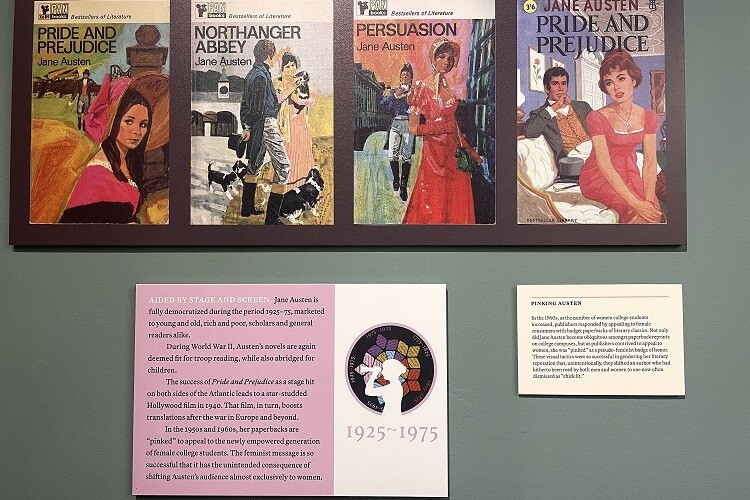
Over the years, Jane Austen's works have gone through different stages: from being published in cheap editions for 'ordinary readers' to being read in the trenches of World Wars and finally being sold as 'literature for girls'. Before World War I, Jane Austen was 'adored by the elite' and read mainly by men, but during the conflict, soldiers began to read the author, as her books were sent to the front through the War Services Library program. At the Grolier Club headquarters, next to an exhibited copy that compiles 'Pride and Prejudice' and 'Northanger Abbey', there is a print from the War Services Library showing a soldier holding a pile of books while carrying a rifle on his back. Later, in the 50s and 60s, Austen's readers became mostly women, as her literature was specifically marketed to this audience to attract 'a new generation of empowered women who can now go to university'. Beyond books, the Grolier Club also exhibits a fragment of a letter that Austen sent to her brother in 1814 in which the writer tells him about the upcoming release of her novel 'Mansfield Park'. The exhibition also takes a tour through Austen's representations in popular culture, with tickets to theatrical adaptations, thematic tarot cards, posters from films signed by the actors, and even the DVD of 'Clueless', the 1995 film based on 'Emma'.