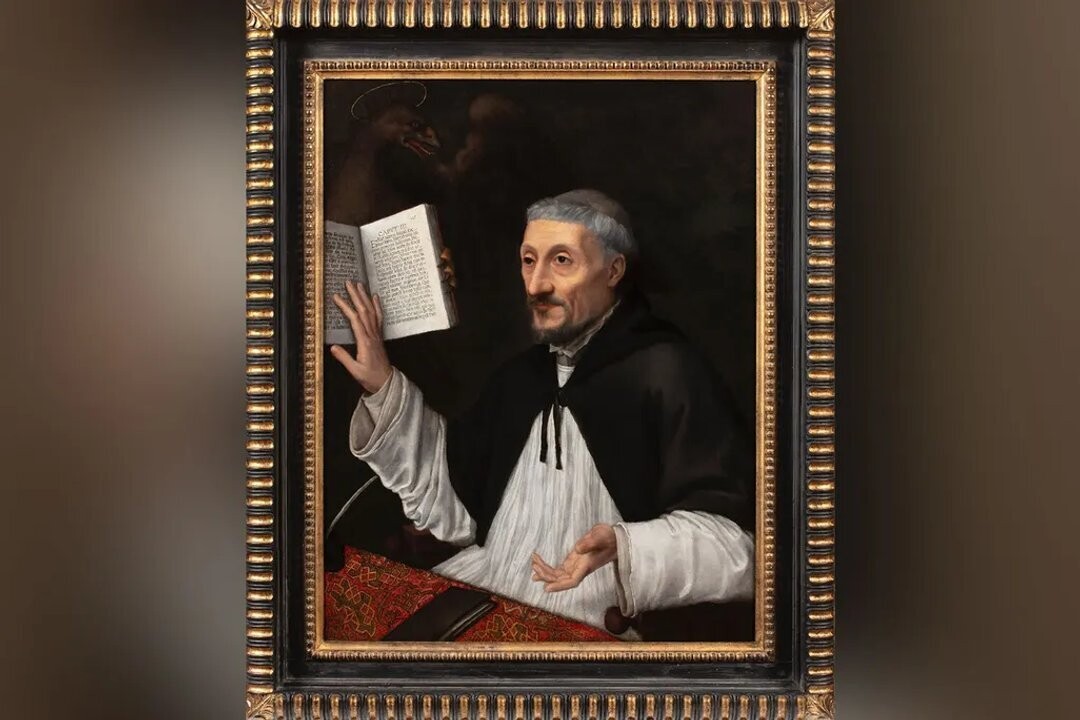
A portrait that had been lost for decades resurfaced in New York, reigniting interest in one of the most notable artists of the Italian Renaissance. The work in question is 'Portrait of a Canon Regular' (1552) by Sofonisba Anguissola, recently presented at the Winter Show, the art fair held at the Park Avenue Armory on the Upper East Side. The painting depicts an unidentified cleric in full discourse. With his right hand, he points to an open Bible in the Gospel of John, while an eagle—the symbol of the evangelist—holds the book with its claws, emerging from a dark background that accentuates the drama of the scene. In recent decades, however, her figure has been re-evaluated, and she is now considered one of the great figures of the late Renaissance. The return of 'Portrait of a Canon Regular' not only expands Anguissola's known body of work but also reaffirms the power of an artist who, in Simon's words, must have been exceptional to make her way in a world that offered little space for women. At 20, when she painted this portrait, she already demonstrated a compositional maturity that surprised her contemporaries. In 1559, she was summoned by Philip II to join the Spanish court as a lady-in-waiting to Elizabeth of Valois. For 14 years, she painted the royal family and taught drawing to the queen. Later, she settled in Sicily, where she lived until her death in 1625. Although she enjoyed prestige in her lifetime—Giorgio Vasari praised her 'grace' and the almost tangible quality of her portraits—her name was eclipsed over time, and some of her works came to be attributed to masters like Titian. In 2024, art historian Michael Cole, author of 'Sofonisba’s Lesson,' gave a lecture on the painter at the National Gallery of Art in Washington. The talk was posted on YouTube and seen by the owners of a private collection in Durham, North Carolina. Intrigued, they contacted Cole to inquire about a work acquired by their family at a local auction in 1977. The specialist traveled to the location and confirmed the painting's identity: it was the lost portrait. Gallery owner Robert Simon, of Robert Simon Fine Art, was initially called in to appraise the piece and advise on its conservation, provenance, and framing. Eventually, the owners decided to sell it, and Simon presented it at the Winter Show with a price of $450,000. Following a recent restoration, the artist's full signature came to light: 'Sophonisba Anguissola Virgo,' followed by the date 1552, making the work the earliest signed and dated painting by the artist. Who was Sofonisba Anguissola. Born in Cremona around 1532, Anguissola received decisive support from her father to train as an artist at a time when women rarely had access to that field. Her talent caught the attention of Michelangelo, who corresponded with her family. On the desk, a Turkish tapestry, a resource common in the artist's work, adds texture and refinement. According to Smithsonian Magazine, the piece, one of fewer than 20 signed paintings by Anguissola still in existence, had been off historians' radar for almost a century. The Frick Art Reference Library had a black-and-white photograph from the 1920s, but then all traces were lost. Her cleric, suspended between word and shadow, now reclaims the place history had denied him.