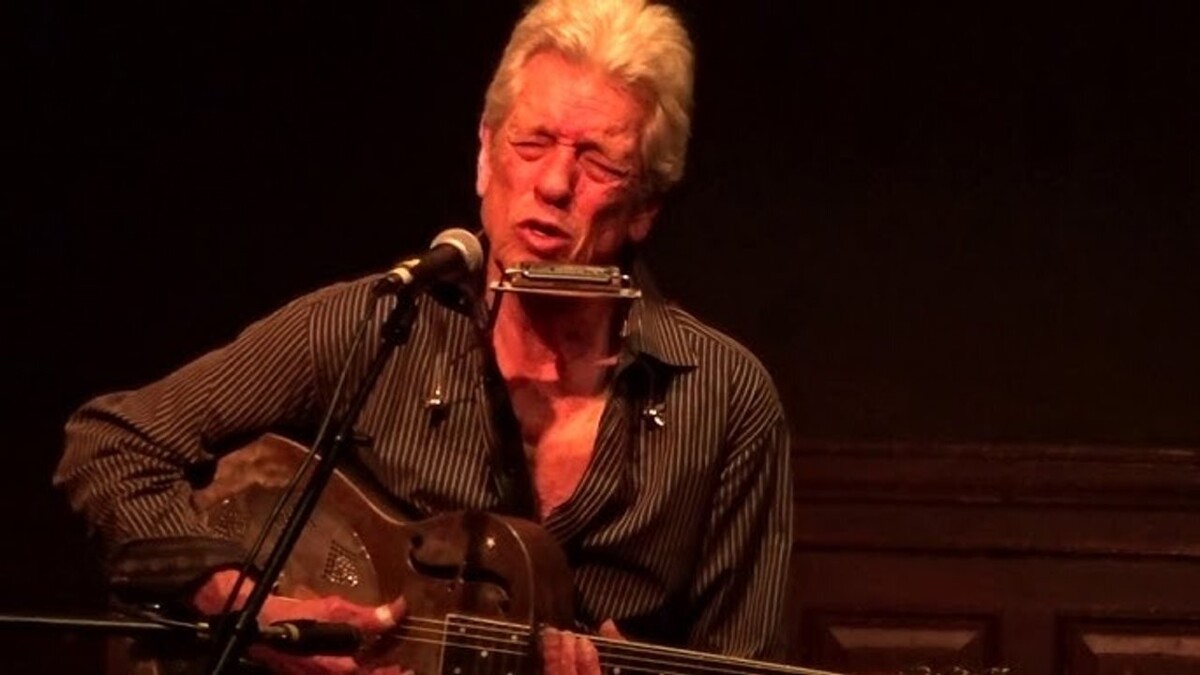
The next time I saw him, a year later, he was already a star in Europe,” Hammond would recall decades later. Throughout the sixties and seventies, he recorded and played with musicians like Robbie Robertson, Duane Allman, Charlie Musselwhite, Michael Bloomfield, and David Bromberg, expanding his sound palette without abandoning his roots. He was barely 20 years old when he was interviewed by The New York Times and was already considered a significant artistic figure. Some critics described him as a “white Robert Johnson,” a comparison he never sought but which illustrates his interpretive intensity. Hammond built his own identity: solo on stage, acoustic guitar, harmonica strapped to his neck, raspy and expressive voice, and a sober presence that brought to life songs from the thirties, forties, and fifties. However, he also knew how to lead electric formations with skill and energy. In 1966, while living in New York's Village, he witnessed the arrival of a young guitarist named Jimi Hendrix in search of opportunities. Seeing Jimmy Reed at the Apollo Theater marked a point of no return. In the midst of the American folk revival, in the early sixties, Hammond abandoned a scholarship at Antioch College to dedicate himself fully to the blues. By 1962, he was already a regular on the East Coast's coffee shop and festival circuit, where he performed the repertoire of masters like Mississippi John Hurt, Reverend Gary Davis, and Skip James, figures rediscovered by that first great “renewal” of the genre. It was there that he was discovered by Chas Chandler, who would take him to England and catapult him to fame. Hammond helped him get gigs at the Cafe Au Go Go. In the new millennium, he released albums such as “Ready for Love” (2002), produced by David Hidalgo, “In Your Arms Again” (2005), “Push Comes to Shove” (2007), the raw “Rough & Tough” (2009), and the solo live album “Timeless” (2014). Hammond never presented himself as a composer. His mission was different: to safeguard and revitalize the classic blues songbook. With each performance, he invited the audience to travel back in time and discover the original authors. Hammond died this Saturday, February 28, at the age of 83, according to sources close to his artistic circle. Born on November 13, 1942, in New York, Hammond was the son of the legendary Columbia Records talent scout John Hammond Sr., although he did not grow up with him after his parents' separation. His sentimental upbringing, more than domestic, was musical: he discovered the guitar in high school and became fascinated with the slide technique. His death closes an essential chapter in modern blues: that of an interpreter who understood that tradition is not a museum, but a fire that is kept alive by passing it from hand to hand. That task—more curatorial than authorial, but no less creative—earned him the respect of his peers and critics. He was twice in Argentina. The first time he opened for the legendary Albert Collins at the Teatro Gran Rex, in the nineties, and the second was with his own show at the ND Ateneo in 2005. Based in northern New Jersey, he continued to tour the United States, Canada, and Europe into advanced age. On stage, whether solo or with a band, he retained the intensity of his beginnings. His discography, which exceeds two dozen albums, includes essential recordings such as “I Can Tell”—recorded with Bill Wyman—, “Southern Fried” (1968), “Source Point” (1970), and the series of works for Point Blank/Virgin in the nineties, among them “Got Love If You Want It,” “Trouble No More”—produced by J.J. Cale— and “Found True Love”.