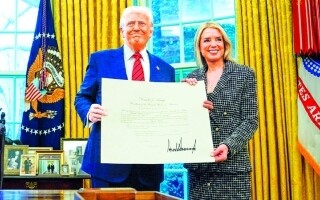
A U.S. Department of Justice spokesperson stated, "The Department is committed to ensuring taxpayer funds are used efficiently by hiring the best and most qualified individuals to serve the American people, with a focus on those performing critical law enforcement and public safety tasks." However, labor law experts are concerned that some officials in President Donald Trump's administration are finding ways to circumvent the hiring process to ensure that new employees in non-political positions align with the president's policies. For example, when prospective DOJ applicants apply for a job, they are now required to detail a Trump executive order or policy that is important to them and explain how they would advance that initiative.
The U.S. Department of Justice has lost thousands of experienced lawyers since the beginning of President Trump's current term, and only a small fraction of the vacant positions have been filled. The process has stalled due to a lack of qualified candidates, bureaucratic delays, and a hiring freeze, according to people familiar with the department's hiring operations. Last year, about 10,000 lawyers and a number of judges worked in the DOJ and its components, including the FBI. "Justice Watch," an advocacy group that tracks employee departures from the department, estimates that about 5,500 people—not all of them lawyers—have resigned from the DOJ, been fired, or accepted a buyout offer from the Trump administration.
The DOJ has not provided details on the departures of its lawyers, but officials have not denied the existence of widespread vacancies. The department's struggle to fill its vacancies reflects a radical shift for a law enforcement agency that has long attracted top-tier law school graduates and the nation's highest-rated law firms.
Many people familiar with the student bodies at top law schools and the DOJ's hiring process say the proportion of new graduates from across the political spectrum applying for jobs at the DOJ has dropped sharply. The department has also had difficulty finding qualified candidates for its open positions, according to more than six people familiar with the process, many of whom spoke on condition of anonymity because they were not authorized to comment on the matter.
Across the United States, U.S. Attorney's offices have seen a higher rate of employee departures than is typical during an administration transition. In August of last year, U.S. Attorney for the District of Columbia Jeanine Pirro told Fox News that her office had lost 90 prosecutors and asked lawyers in the private sector to apply if they were interested in a job. In Chicago, U.S. Attorney Andrew Miers sent an email over the summer to former prosecutors, asking them to consider applying for jobs as assistant U.S. attorneys and to forward his message to friends who might be interested.
Retired attorney Mark Rotert, who worked as a federal prosecutor in Chicago in the 1980s and 1990s and received the recruitment email from a friend, said, "I was shocked. I'd never seen anything like it. When I first came to the U.S. Attorney's office, I had won 13 murder cases at the state level, and yet I thought my chances of getting a job were slim because the competition is so fierce." He added, "Now it's like asking, 'Do you want to be a football player?'" Former Georgetown Law Center Dean William Treanor said, "The DOJ has historically been one of the most attractive places for our graduates. What we're seeing is a sharp drop in the number of applicants; it's gotten to the point where no one is applying for jobs at the DOJ." Many lawyers seeking government jobs are choosing to work for state governments, leading to a significant increase in the number of qualified candidates for positions in state attorney general's offices.
For some, the decline in applicants from top law schools like Georgetown, Yale, and Harvard is good news. Both Republicans and Democrats have criticized the legal field as being too elitist. The Trump administration has repeatedly attacked DOJ employees as being too liberal and prone to undermining the president's authority. Trump and his aides have also attacked the country's top universities, launching investigations and trying to punish them for what they described as unfair admissions policies and diversity, equity, and inclusion policies.
If the Trump administration can fill most of the vacancies, it could lead to a radical reshaping of its workforce. People familiar with the hiring process say current applicants tend to be more cautious and ideologically aligned with the president. Current DOJ job candidates are likely to have more political backgrounds than in the past, coming from Republican congressional offices and lobbying groups, while others are young lawyers with little experience or mid-to-late-career lawyers without litigation experience.
According to data compiled by "Justice Watch," an advocacy group that tracks employee departures from the U.S. Department of Justice, at least 200 people have been fired since President Donald Trump took office. Immigration judges working in the department accounted for about 80 of these terminations. White House officials are struggling to fill these immigration judge vacancies as cases pile up, according to a person familiar with the matter who spoke on condition of anonymity because they were not authorized to speak publicly. Government lawyers typically earn much less than those in the private sector. First-year associates at major law firms can earn more than $230,000 a year, plus large annual bonuses. In contrast, first-year assistant U.S. attorneys in some cities earn around $70,000.
The DOJ has confirmed that it is hiring the most efficient individuals. Experts note that the spirit of the new question in the hiring process requires the applicant to declare loyalty to the president. The process for filling professional positions in the United States differs from the appointment of political officials, as professional positions are subject to federal regulations designed to ensure that politics does not influence who is appointed. The Trump administration has fired many senior career officials at the DOJ and replaced them with political appointees, many of whom came from Republican state attorney general's offices and conservative legal groups. However, dozens of professional legal positions remain vacant across the country.