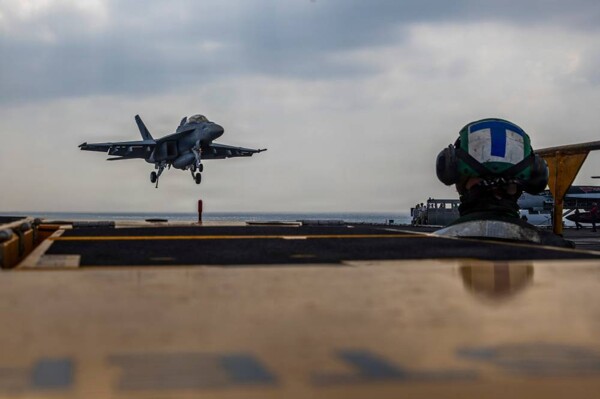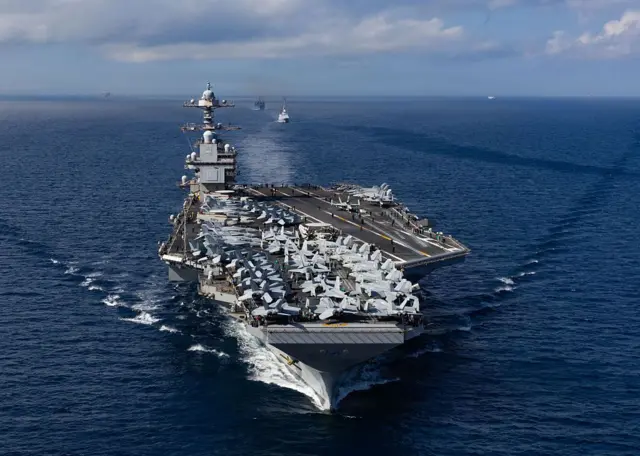
Washington, November 13, 2025 – Total News Agency-TNA- U.S. Secretary of Defense Pete Hegseth announced this Thursday the launch of the so-called 'Operation Southern Spear,' a military offensive in the Caribbean and the Eastern Pacific aimed at combating what Washington calls 'narcoterrorism' in the Western Hemisphere. In this regard, a Pentagon spokesman stated that this is 'an action that transcends the traditional interdiction of drugs and approaches a first-order national security conflict.' Reactions in the region were not long in coming: the government of Nicolás Maduro in Venezuela qualified the operation as a threat to its sovereignty and mobilized military forces in response. On his social media profile X, he emphasized that the Caribbean is 'the neighborhood of the United States' and that the operation will involve a continued deployment of naval, air, and surveillance forces. The operation is directly linked to the recent entry of the USS Gerald R. Ford (CVN-78), the world's largest surface vessel, into the area of responsibility of the U.S. Southern Command (USSOUTHCOM), which arrived in the Caribbean accompanied by its strike group to reinforce the operational capability of the United States in the region. However, it also extends the debate on precedents for military intervention and on the limits of the use of force in anti-narcotics operations. Operationally, the head of the Southern Command, Admiral Alvin Holsey, stated that the deployment of the aircraft carrier and its strike group will allow 'sustaining prolonged operations in multiple scenarios, reinforcing control over narcotics maritime routes, and increasing pressure on transnational drug trafficking organizations.' Thus, a new U.S. doctrine for the region is established: the fight against narcotics is no longer limited to the police sphere or basic naval interdiction but is formalized as a wide-ranging military operation with sustained presence and with a first-line aircraft carrier as a symbol of deterrence. The regional analysis lens highlights that the intercepted ships and attacks on vessels linked to narcotics have already generated an increase in diplomatic tension, criticism from human rights organizations, and questions about the international legality of extraterritorial operations. Nevertheless, in Washington, the discourse prevails that the 'neighborhood' of the Caribbean requires a public and dominant response to the flow of illicit drugs and arms that, according to its authorities, threatens the country's internal security. Ultimately, Operation Southern Spear opens a more aggressive chapter in the U.S. approach to hemispheric security and the fight against narcotics. Nevertheless, specialized media indicated that since September, there have already been about twenty U.S. attacks on vessels allegedly linked to narcotics, with at least 76 people killed. The strategic axis of the agreement includes a combination of advanced maritime surveillance, unmanned aerial devices, joint intelligence operations, and an increase in permanent naval presence in the area. According to reports from the Department of the Navy, this arrival aims to 'detect, monitor, and dismantle illicit actors that compromise the security of the country and the Western Hemisphere.' The press release from the Pentagon does not precisely detail all the phases of the operation or the specific objectives, which raises questions among allies and international organizations. According to the official Pentagon communiqué, the action responds to a direct order from President Donald J. Trump and will be led by the Joint Task Force Southern Spear in coordination with the United States Southern Command (USSOUTHCOM). Hegseth stated that the mission's objectives are 'to defend our homeland, expel narcoterrorists from our hemisphere, and protect our homeland from the drugs that are killing our people.' The diplomatic environment was further complicated by framing this move within the U.S. foreign policy towards Latin America and its economic and geopolitical implications. For Argentina, a strategic ally in the region, the announcement is of special interest, as it opens the possibility of collaboration with U.S. Navy and Southern Command units, intelligence exchange, and participation in joint anti-drug operations. The success of this initiative will depend not only on the military and technological capabilities deployed but also on coordination with regional governments, respect for international law, and the strategic sustainability of a mission that the United States intends to prolong over time.