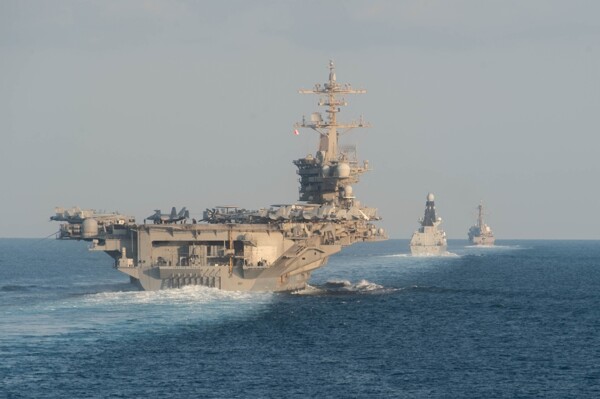
The terrorism label is nothing more than a Trump maneuver to intervene in Venezuela, Colombia, and Mexico. The Donald Trump administration uses the terrorism category as a political tool, enabling sanctions, extraterritorial operations, and direct pressure on Venezuela, Mexico, and Colombia. This strategy relies on a legal vacuum in U.S. regulations, a confrontational discourse, and an unprecedented military deployment in the Caribbean, where the largest U.S. aircraft carrier, a nuclear attack submarine, and thousands of troops were mobilized. Trump has broadly interpreted domestic legislation governing counter-terrorism, relying on the International Emergency Economic Powers Act, which grants powers and allows action without congressional approval or verified evidence. This reinterpretation sets a precedent that redefines who the White House can pursue and what military actions can be justified under the umbrella of national security.
Venezuela under Political and Military Fire The heart of the U.S. strategy is Venezuela. The Colombian leader recalled that his government has seized over 2,700 tons of cocaine since 2022, a historic figure, and has approved hundreds of extraditions requested by the United States and Europe. The Colombian president has bluntly reiterated that Washington is trying to pressure his country for refusing to participate in a potential military aggression against Venezuela.
A Doctrine Against Latin American Sovereignty The reinterpretation of terrorism is not a technical or semantic shift. Governments and multilateral bodies—including CELAC, ALBA-TCP, CARICOM, and UNASUR—warn that allowing the United States to unilaterally impose its own definition of terrorism would risk continental sovereignty and open the door to new interventions under legal criteria constructed outside the region. In this scenario, the White House's attempt to rewrite the continent's security rules is part of a larger dispute. The debate no longer revolves solely around narcotics or organized crime but rather on who sets the limits of power in Latin America and whether the hemisphere's states will accept that their internal stability depends on legal interpretations designed to expand the scope of U.S. action.
Mexico and Colombia Resist Pressure Mexico faces a delicate scenario. Trump accused President Gustavo Petro of being a drug trafficker without evidence and suspended financial assistance to Bogotá. Petro responded: “Drug traffickers live in Miami, New York, and Paris, not in the boats where missiles fall that only kill poor people and Latin American migrants.” Meanwhile, the CIA was authorized to operate on Venezuelan soil, and the Pentagon released videos of explosions at sea attributed to drug trafficking boats. To date, 83 people have died in 21 attacks whose location, context, and criminal links have not been verified.
Maduro has responded clearly. This policy does not substantially differ from the doctrines of the past that used the fight against communism, drugs, or terrorism to justify military operations, economic blockades, or political destabilizations. The naval deployment in the Caribbean has not proven effective in the fight against drugs, but it alters the regional strategic balance and serves as a mechanism of intimidation. The regional impact has generated harsh responses.