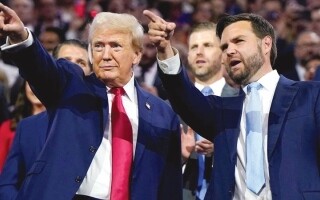
The recent fine imposed by the European Union on X, owned by Elon Musk, amounting to 120 million euros, is not, contrary to J.D. Vance's claims, an attack on freedom of expression, but merely the enforcement of European transparency laws. Within the framework of the new American national security strategy, Donald Trump, Vance, and their supporters have expressed their rejection of the European Union itself, viewing it as a 'supranational' entity that threatens national sovereignty. While this 'West' may not have ended forever, it is as good as over as long as Trump or Vance are in the White House. The Real TestFrom now on, Europe must act as if it relies on itself. Although these countries may not achieve the levels of prosperity they aspire to, they have the capacity to continue supporting Ukraine, which stands as an obstacle to an American administration that wishes to end the war in Ukraine as a hindrance to rebuilding trade relations with Russia. There is no doubt that European companies are lagging behind their American counterparts in many areas of digital technology, yet the importance of Europe is also demonstrated in the fierce reaction shown by Trump and his vice president Vance to the fine imposed by the EU on December 5th on the company X. When U.S. President Donald Trump, his vice president J.D. Vance, and several of their supporters spend their time criticizing and belittling Europe, the core issue does not lie in the accuracy or error of these criticisms, nor even in how European leaders should respond, but in the most important question: what drives those who champion the 'America First' slogan to go to such lengths to tarnish the image of countries on the other side of the Atlantic?The answer to this question lies in the real weight that Europe still possesses, despite all the talk of its weaknesses. This negative American interest is, in essence, nothing more than an indirect acknowledgment of Europe's importance, and can even be considered a form of unwanted flattery.Points of StrengthIn reality, Europe derives its importance from its points and elements of strength, not from the manifestations of weakness that Trump and Vance accuse it of. This does not mean ignoring the United States or entering into a direct confrontation with it, but rather making independent decisions and welcoming American support when it is available, without waiting for permission or a green light from Washington, which many European leaders did in the first half of this year. The real test of this approach was the continued financial support for Ukraine, especially the proposal to grant it a loan using the assets of the Central Bank of Russia frozen in European banks since February 2022. The EU has already approved the activation of emergency powers under Article 122 of the Treaty on European Union to freeze these assets indefinitely, a step likely to earn Trump's own respect, given his own reliance on emergency powers to impose tariffs. This procedure will prevent pro-Russian governments, such as that of Hungary, from blocking the loan by disrupting the sanctions system that led to the freezing of Russian assets in the first place.Indeed, leaders of the European Union, yesterday, reached an agreement to provide a 90 billion euro loan to Ukraine to cover the expected deficit in its budget, but they failed to find a solution to use the frozen Russian assets for financing.By making a decisive decision on this file, or finding an alternative and rapid mechanism to finance Ukraine if an agreement is impossible, European leaders confirm their real strength and strengthen Ukraine's negotiating position against both Russia and the United States. Europe can also show more strength by proposing practical initiatives to send military forces to Ukraine to ensure its security in the event of reaching a ceasefire agreement with Russia. Moscow has already threatened to consider any European forces on Ukrainian soil as legitimate military targets. However, the truth is that the creation and development of the European Union were the product of sovereign democratic decisions of its member states, not a threat to their sovereignty as is being promoted. It is clear that the European Union does not pose a real threat to American security, especially since 23 of its 27 member states are allies of the United States within NATO. But what actually threatens the Union is the absolute freedom enjoyed by American Big Tech companies on the internet, on which Trump and Vance politically rely. The EU's regulatory power directly affects the profits and influence of these companies.The Decline of the American StatusEurope's importance to the current U.S. administration is also growing from other angles. Its advanced results in the health field, more efficient social care systems, and great attention to issues such as climate change and reducing inequality are all factors that highlight the decline of the American status even in the eyes of its own citizens, let alone the outside world. From this standpoint, Europe becomes a mirror that reflects to the United States an image that is not always pleasing, which arouses Trump's anger, just as democratic Ukraine arouses Russian President Vladimir Putin's anger.Therefore, these American attacks should not be viewed as a 'wake-up call' for Europe, as many of them are based on incorrect claims, and Europe has long since begun to respond to fundamental challenges, such as increasing military spending, expanding defense industries, and enhancing its diplomatic presence. The concept once known as the 'West' is no longer existing if the United States, which has led this bloc for decades, is waging a political war against Europe while avoiding classifying Russia and China as threats. If Russia is serious about this threat, it clearly means it is not serious about reaching a ceasefire or a real peace, and here it falls upon Europe to uncover the true intentions of both Vladimir Putin and Donald Trump.Bill Emmott**Former Editor-in-Chief of The EconomistAsia TimesA WarningThere is still much Europe needs to accomplish, and some European countries have not yet grasped the scale of the current security threats, however, the European continent is clearly moving in the right direction in many areas. Leaders of the European Union and the United Kingdom should view the attacks of U.S. President Donald Trump, despite their crudeness and often lack of decorum, as a warning that the political alliance the Western world has relied on for peace for eight decades is at risk of falling apart. Europe's progress in the health sector, more efficient social care systems, and its focus on issues like climate change all highlight the decline of the American status.The European Union does not pose a real threat to American security, especially since 23 of its 27 member states are allies of Washington within NATO.Since Russia invaded Ukraine in February 2022, European countries and institutions have been responsible for providing nearly two-thirds of the total military and financial aid received by Kyiv, according to the Ukraine Support Tracker by the Kiel Institute, as well as over 95% of the aid that has been pledged but not yet disbursed. Furthermore, the EU's economy is eight times larger than Russia's, or ten times larger if the United Kingdom is included.