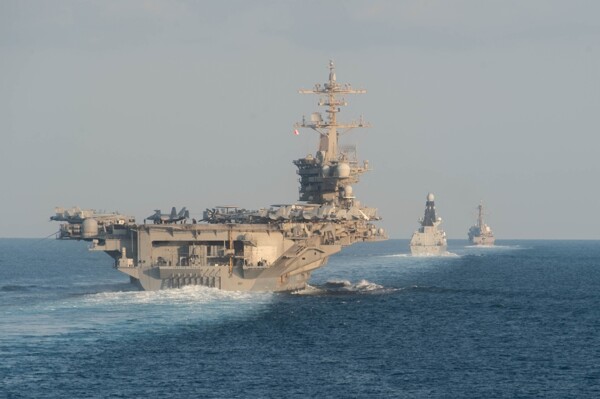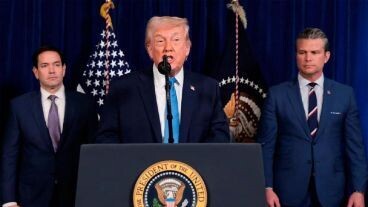
The Senate recently advanced in a bipartisan resolution to restrict the president's ability to undertake new military actions in Venezuela without the approval of Congress, evidencing growing tensions over the limits of executive powers in foreign policy. The decision to cancel the second wave of attacks represents a turning point in the dramatic escalation between Washington and Caracas, which has had repercussions throughout Latin America and has once again placed the South American country at the center of the international geopolitical agenda. WASHINGTON D.C., January 9, 2026 – Total News Agency-TNA-U.S. President Donald Trump announced this Friday the decision to cancel the second wave of planned military attacks against Venezuela, a decision he attributed to the 'cooperation' received from the new Venezuelan government following the capture of President Nicolás Maduro and the release of a group of political prisoners. The release of political prisoners, celebrated by Washington as a step forward, was interpreted by sectors of the international community as a strategic gesture by the interim government led by Delcy Rodríguez, who assumed duties after the capture of the Chavist leader. Among the details of U.S. policy towards Venezuela, Trump announced that in the coming days he will receive opposition leader María Corina Machado in Washington, a significant gesture towards sectors opposed to the Chavist regime. The president also stated that, although it is not the time to speak of elections in Venezuela after the capture of Maduro, the focus must first be on the 'reconstruction of the country.' In parallel, Trump anticipated that the United States will expand actions against drug cartels, including potential ground operations in countries like Mexico, within a broader framework of his strategy against transnational criminal organizations that, according to his administration, have direct or indirect links to the Venezuelan crisis. On the domestic front in the United States, Trump's approach has generated mixed reactions. The Republican leader disseminated the information on his social network Truth, in a significant shift in Washington's policy towards Caracas that marks an apparent de-escalation of the direct confrontation between the two countries. Trump affirmed that the so-called 'second wave of attacks,' which had been announced after a first military operation that culminated in Maduro's capture in Caracas, 'seems unnecessary' due to progress in bilateral cooperation, especially in the matter of releasing political hostages and projects for the reconstruction of Venezuela's energy infrastructure. According to the U.S. president, Venezuela has shown 'a very important and intelligent gesture' by releasing a 'large number' of political prisoners as part of what he described as a 'search for peace.' In addition to highlighting the release of detainees—which included opposition figures and human rights activists, among them leaders like Biagio Pilieri and Enrique Márquez, as well as foreign citizens—Trump underscored that the United States and Venezuela will work together 'especially in the reconstruction… of their oil and gas infrastructure,' pointing to future economic and investment agreements. Nevertheless, the head of the U.S. executive clarified that although the second wave of attacks has been canceled, the U.S. naval forces deployed in the Caribbean will remain in their position for 'security reasons,' a sign that the risk of confrontation is not completely dissipated. Trump's decision comes in a context of strong bilateral tension, which included the controversial U.S. military incursion that resulted in the detention of Maduro on January 3 and sparked intense international controversy over the legality and geopolitical implications of the operation. The development of these relations, especially in the energy and regional security spheres, will continue to be the subject of attention in the coming days. Sources: Reuters, The Guardian, France24, Infobae, PanAm Post, AP News, NBC Miami, El Confidencial, Wikipedia (U.S. attack on Venezuela of 2026; Delcy Rodríguez).