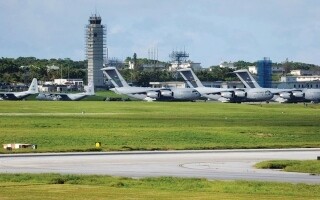
In an article published by Foreign Policy in June 2023, Derek Grossman points out that the U.S. renewed and strengthened its 'Compact of Free Association' agreements with Micronesia, Palau, and the Marshall Islands that year. This granted the U.S. military exclusive rights to establish military bases and access to vast areas of the Pacific Ocean, which effectively creates a 'fast track for force enhancement' spanning maritime areas the size of the continental U.S. China criticized these steps as Cold War-era thinking, while U.S. officials stated that the preparations aim to prevent conflict or ensure readiness if deterrence fails. Rachel Cohen, in an article published by Air Force Times in December 2021, notes that operations in the Middle East showed that preparing a fighter jet to launch again after returning from a mission takes about three hours. However, this speed may not be enough to match China's capabilities in target acquisition. As the U.S. seeks to redeploy its air power across the Pacific, observers question whether the U.S. deployment can remain ahead of China's intensive efforts in surveillance and missile deployment and be decisive in a potential war over Taiwan. Recently, Newsweek reported that the U.S. is reviving dozens of World War II-era airfields across the Pacific as part of a comprehensive military effort to prepare for a potential clash with China. Led by the U.S. Air Force under the principle of 'Agile Combat Employment,' the initiative aims to deploy U.S. air power across a wider network of bases to reduce vulnerability to Chinese missile strikes. Sadler notes how surprising it is that China's investments in dual-use facilities, like ports and airports, continued without hindrance for a long time. Despite these risks, the U.S. is striving to maintain a viable Agile Combat Employment strategy. Military engineers from the U.S. Air Force, Navy, and Marine Corps are rehabilitating abandoned runways on remote islands, including Tinian in the Northern Mariana Islands, Guam, Palau, as well as locations in Micronesia, the Philippines, and Alaska. The engineers are working to make them operational-ready, updating facilities to accommodate modern aircraft. These efforts reflect the growing concern within the U.S. Department of Defense (Pentagon) over China's expanding arsenal of ballistic missiles, which could threaten major U.S. bases like Guam and Okinawa in the initial stages of any potential war, especially around Taiwan. By increasing the number of airfields, pre-storing fuel, ammunition, and repair equipment, U.S. planners aim to complicate Chinese targeting operations, continue combat operations after attacks, and enhance deterrence. The largest project, 'North Field' on Tinian, is expected to be operational by 2027, a timeline that U.S. officials consider a period of increasing risks. China has criticized these steps as Cold War-era thinking, while U.S. officials state that the preparations aim to prevent conflict or ensure readiness if deterrence fails. As noted by Kelly Greco and others in an article published by Stimson in December 2024, destroying targets like fixed airfields and aircraft on the ground is far easier than destroying moving targets. Chihwei Yu, in a report from the Jamestown Institute in July 2024, points out that China's investments in ports and airports and its partnerships in the South Pacific, particularly in the Solomon Islands, Fiji, and Samoa, enhance its military influence and give it the ability to monitor key maritime and air routes. According to an article by Brent Sadler published by the Heritage Foundation in December 2025, Chinese airfields on the islands could complicate U.S. efforts to relocate aircraft that have come under attack. In a report from the Center for Strategic and International Studies in January 2023, Mark Cancian and other authors warned that U.S. aircraft losses in a Taiwan conflict would be catastrophic and concentrated in the first phase. Cancian and others indicate that during a war simulation, the U.S. would lose about 300-500 aircraft in the first weeks of combat. In testimony in March 2024 before a committee on U.S.-China economic and security relations, Michael Dam stated that China's reconnaissance and surveillance system has reached a level sufficient to enable it to target U.S. air bases in the western Pacific in case of a conflict over Taiwan. Dam says that as of January 2024, the Chinese military operated over 359 reconnaissance and surveillance satellites, more than three times the number in 2018, including 14 in geostationary orbit (compared to six in 2020) and a group of low Earth orbit satellites, three times more. Dam adds that Earth-synchronized signals intelligence satellites, like TJSS-1, can continuously pinpoint the geographic locations of U.S. signal sources across the Indian and Pacific regions, while JEO electro-optical and advanced radar satellites can detect fixed targets, including airfields. Additionally, Dam says that this reconnaissance, surveillance, and intelligence network, along with an 'over-the-horizon radar' that can detect aircraft up to 3,000 kilometers away, supports the Chinese military's air strike operations. A Chinese preemptive attack on U.S. airfields in the Pacific could be devastating. Greco and others cite writings from the People's Liberation Army of China, which emphasize that air bases are a weak point for U.S. air power in the Pacific and stress the need to destroy them (in case of war) early on to prevent U.S. fighter aircraft, such as bombers and fighters, from taking off. However, the 'Agile Combat Employment' strategy is based on the idea that the U.S. can relocate its aircraft among multiple air bases faster than China can track them, leveraging its intelligence, surveillance, and reconnaissance capabilities. They add that 90% of these losses occur on the ground, not in air-to-air combat, where Chinese ballistic and cruise missiles would destroy U.S. and allied air bases in Japan and Guam before aircraft can take off. As for how such strikes would affect the timeline of potential U.S. intervention, Greco and other analysts point out that such attacks could make U.S.-controlled runways and taxiways in Japan inaccessible for the first 12 days of a conflict, hindering essential fighter operations needed to support Taiwan. Furthermore, analysts highlight that aerial tankers would not be able to operate from Japan for more than a month, hindering the ability of U.S. aircraft to reach the Taiwan Strait or the South China Sea. According to Greco and other analysts, this could significantly reduce sortie rates, delay bomber deployment, and possibly give China a 30-day window of air superiority to accomplish its mission swiftly. Moreover, China's expanding presence in the South Pacific could significantly restrict the freedom of movement of U.S. forces.