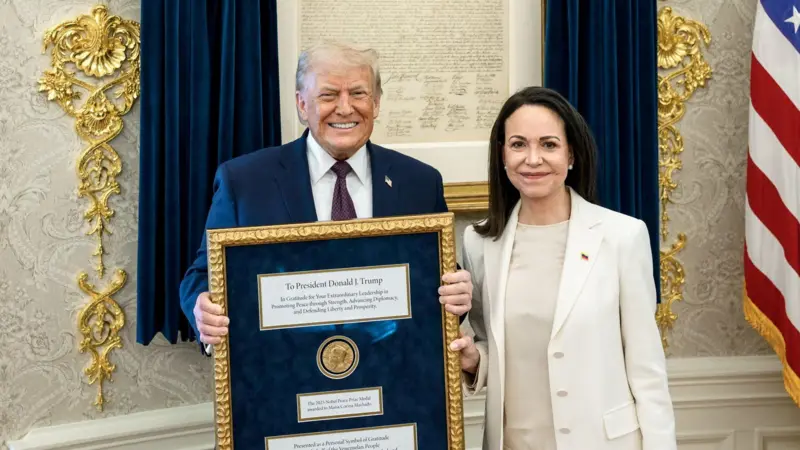
Venezuelan opposition leader and Nobel Peace Prize laureate María Corina Machado stated that Venezuela is moving towards a “true transition” and emphasized the political backing received from U.S. President Donald Trump following a key meeting at the White House. The meeting was marked by a symbolic gesture related to Trump's ego, which reconfigured his link with Washington: the personal cession of his Nobel Peace Prize medal. Machado spoke from the U.S. capital a day after the meeting with Trump, in which she expressed her intention to return to Venezuela “as soon as possible” and to actively participate in the political process that opened after the capture of former president Nicolás Maduro. The leader insisted that her leadership is not based on immediate personal ambition, but on a “historical mission” aimed at rebuilding the country and re-establishing popular sovereignty. Machado's gesture came amid ambiguous signals from the Trump administration towards Caracas. This unprecedented move in regional politics once again put her name at the center of the international debate on Venezuela. The evolution of the relationship between Machado and the White House will be decisive for her political projection and for the design of the transition process in the South American country, in a context marked by delicate balances between stability, democratic legitimacy, and the strategic interests of the United States. In public statements, the leader maintained that the country is going through a decisive stage and that change must have the explicit support of the Venezuelan people. The opposition leader stressed that the interim president, Delcy Rodríguez, does not represent the popular will and that her role responds to a logic of administrative continuity rather than full democratic legitimacy. In diplomatic circles, the maneuver was interpreted as a clever move that outmaneuvered Trump's ego and facilitated a direct channel for dialogue at a key moment for Venezuela's future. In subsequent statements, Machado affirmed that she aspires to be president of Venezuela “when the right moment comes” and showed herself convinced that she will be the first woman to hold that office. While the U.S. president received and praised her political struggle, his government maintains an operational link with Rodríguez, whom he considers key to guaranteeing institutional stability and control of the security forces in the short term. Nevertheless, she showed confidence that the ongoing process will result in an orderly transition, without anticipating dates or electoral calendars to avoid generating false expectations. One of the most relevant aspects of the meeting with Trump was Machado's decision to personally and symbolically hand him the Nobel Peace Prize medal she recently received. According to sources close to the leader, the gesture was conceived as a political signal to unblock dialogue with the U.S. administration, capitalize on Trump's personal interest in the award, and reinforce Machado's centrality as the privileged interlocutor for the Venezuelan opposition in Washington. From Machado's inner circle, they maintain that the cession of the Nobel does not imply any renunciation of international recognition, but rather a strategic move that managed to capture the attention of the U.S. president and generate a climate of greater political receptivity. This duality generated tensions within the Venezuelan opposition, whose hardest sectors awaited explicit and immediate support for an alternative leadership. For international analysts, the cession of the Nobel allowed Machado to reposition herself in this complex scenario, avoiding being relegated before the interim government and reinforcing her image as an indispensable figure in any future transition.