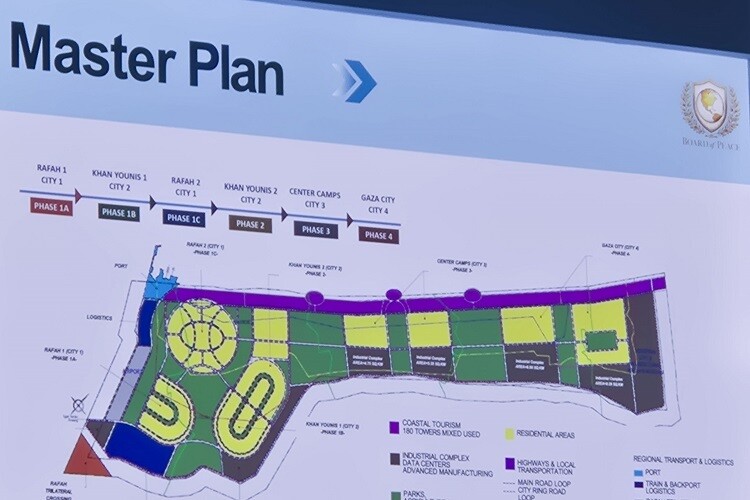
The Trump administration presented this Thursday its plan for the reconstruction of the so-called "new Gaza", conceived as an ambitious urban project full of skyscrapers in a territory of two million inhabitants devastated by three years of Israeli military offensive.
Jared Kushner, Trump's son-in-law and real estate developer, was in charge of presenting the new plan at the World Economic Forum in Davos (Switzerland), where the Peace Board was created, an organism established by the U.S. president to oversee the ceasefire in Gaza and address other conflicts. Trump himself evoked his experience as a builder to highlight the economic potential of the Gaza Strip's location on the Mediterranean coast.
"Look at this beautiful property," he said. "What would the 'new Gaza' be like?" The slides presented by Kushner show gleaming skyscrapers along the Mediterranean coast of Gaza and the creation of new cities in the Palestinian enclave, where more than 70,000 people have died from Israeli attacks since Hamas's October 7, 2023 attacks. The images recall an AI-generated video circulated a year ago, in which Trump proposed expelling Gazans and building a luxury resort called "Trump Gaza", which then caused great outrage.
The current proposal contemplates developing a tourist area along the enclave's 40 kilometers of coastline, with about 180 residential and hotel skyscrapers by the sea, in addition to a large port. The reopening of the Rafah border crossing with Egypt is also expected, according to the new technocratic committee governing the Strip, next week. One of the slides shows a new Rafah with tree-lined avenues and roundabouts, more than 100,000 homes, 200 educational centers, 180 cultural and religious facilities, and 75 medical centers.
Trump's team expects the project to boost Gaza's economy to $10 billion by 2035 and generate more than 500,000 jobs. "Look at this location by the sea," Kushner said. "What would the 'new Gaza' be like?"
Is the project viable? During the presentation, Trump's son-in-law assured that there is no "Plan B" for Gaza's reconstruction and conditioned the start of the works on the complete disarmament of Hamas. However, the situation on the ground makes the plan presented in Davos for now unviable, which lacks concrete dates and details about its possible investors.
Trump's peace plan for Gaza, which began last October, contemplated a ceasefire, the entry of humanitarian aid, and the release of all hostages from the Palestinian Islamist group, but Israeli attacks persist and Hamas still has not handed over the body of one of the kidnapped. Furthermore, negotiations to begin the second phase of the plan, which envisages the disarmament of Hamas, are advancing slowly, and Washington is having difficulties finding countries willing to participate in the deployment of a peacekeeping force in the area.
The interior of the territory would be divided into residential areas, parks and sports zones, industrial, data, and logistics complexes, as well as an airport on the border with Egypt. Kushner estimates that at least $25 billion in investment would be needed for a project that does not yet have a start date, but which, according to the Master Plan, would be executed in four phases: starting in the south and advancing towards the north, leaving the city of Gaza as the last point to be rebuilt. The first city to rise would be Rafah, in the south of the enclave, largely devastated by Israeli attacks.