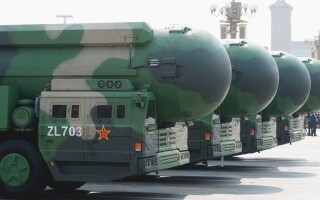
The international arena is witnessing a significant rise in concerns about the possibility of a new nuclear arms race, following the expiration of the 'New START' treaty between the United States and Russia on February 5th. In light of this development, several experts emphasize the need for a negotiated approach based on two parallel tracks to address the nuclear weapons issue and mitigate its grave consequences. The first track focuses on seeking an extension of the 'New START' treaty, despite ongoing sharp disagreements over the mechanism to achieve this. In this context, Ariel Levite, a professor at the University of Maryland, believes it is in the best interest of the United States to accept Russian President Vladimir Putin's offer to extend the treaty, and then work to resume data exchange, activate the limited notification system, and establish a clear mechanism for restarting mutual inspection activities. Researchers Erin Dempsey and John Tierney from the Council on Foreign Relations affirm that accepting the Russian offer serves U.S. interests, provided Moscow agrees to enter into subsequent negotiations and returns, at least partially, to the verification system stipulated by the 'New START' treaty, while reaffirming its commitment to abiding by its provisions. The second track, no less important than the first, involves the United States striving to launch simultaneous negotiations with China on nuclear disarmament. The current level of China's nuclear arsenal is seen as a suitable benchmark that the U.S. could reduce its stockpiles to. Should a common interest, even if informal, emerge between Washington and Beijing to set a ceiling on nuclear arsenals at the current Chinese level, this could exert international pressure on Russia to enter into a trilateral agreement that would achieve a new, lower-level nuclear balance. Such a move would likely garner broad international support, as it represents tangible progress toward reducing the risks of nuclear confrontation and its catastrophic effects. However, some experts warn that continuing to rely solely on the 'New START' treaty as a benchmark could lead policymakers to a state of complacency regarding the need for drastic reductions in nuclear arsenals, which conflicts with the ethical imperative for disarmament. This raises the question of why serious work toward this goal has not begun now, before the opportunity for understanding with China is lost. There are multiple reasons for carefully and simultaneously focusing on these two tracks. Holding talks with China concurrently with negotiations with Russia, but independently of them, would give the United States a better opportunity to understand Beijing's intentions and strategic priorities without complicating the discussions or distracting attention by involving Russia at an early stage. Even if these talks do not yield concrete results, they could pave the way for useful discussions to address the existing misunderstandings between China and the United States. One specialist in nuclear policy at the Carnegie Endowment for International concluded that a deliberate discussion of the long-term consequences of each country's policies, coupled with a nuanced understanding of the other party's perspective, is essential for avoiding the catastrophic outcomes that could result from strategic errors and miscalculations. Another reason for focusing on the two-track approach lies in Russia's inconsistent behavior during negotiations over Ukraine, where Moscow has shown mixed signals. This necessitates that the United States adopt a realistic stance regarding the prospects of achieving a genuine breakthrough in nuclear negotiations with Russia, especially given its intransigence and hesitation on the Ukrainian crisis. The history of these negotiations is likely to cast a shadow on the chances of reaching substantial nuclear agreements, at least as long as the war in Ukraine continues. Thirdly, the nature of the alliance between China and Russia, which takes multiple forms, adds another layer of complexity. Although some researchers, such as Lyle Goldstein, director of the Asian Studies program at the Center for a New American Security, question the depth of this alliance, the United States cannot ignore the concerns about its evolution. During this transitional period, alliances among great powers pose a threat to the fragile nuclear balance that was already fraught with risks when it was confined to the U.S.-Russia relationship alone. A fourth reason is that China has strong motivations to maintain its current level of nuclear arsenal. Goldstein points out that Chinese leaders have wisely concluded that a new cold war, however exaggerated it may seem, would pose a direct threat to China's prosperity and national security. The Communist Party of China has overseen continuous economic growth in recent years, but this momentum has begun to wane, making any massive expenditure on a nuclear arms race an additional burden that could threaten its political legitimacy. The costs of building and maintaining a nuclear arsenal comparable to those of the United States and Russia are a significant political and economic risk for China. In this context, Diana Choyleva, a specialist in the Chinese economy at the Asian-focused consultancy Gavekal, notes that Chinese leadership can no longer rely solely on industrial policies and investment to achieve the growth rates in production and income necessary to sustain its political legitimacy. To achieve tangible progress in nuclear negotiations with China, it is necessary to demonstrate a willingness to cooperate in other specific areas. Among these areas is the possibility of reducing tariffs as an incentive to move nuclear negotiations forward and ease bilateral tensions. Another area highlighted is participation in non-defense technologies as an additional opportunity for building trust, such as cooperation in research into nuclear fusion as a future energy source. Recent reports indicate that China is making significant progress in this area, as covered in a study published in the MIT Technology Review titled 'Why the U.S. and Europe Are Losing the Nuclear Fusion Race.' It is reasonable to assume that nuclear fusion research will not remain the exclusive domain of any single country for long, which reduces the motivations for non-cooperation. Moreover, the potential long-term success of fusion projects could help alleviate one source of international tension—energy security—along with many others. The proposed approach to avoiding a new nuclear arms race is not without serious obstacles. The administration of U.S. President Donald Trump has not shown clear signs of developing the institutional capacity needed to engage in the arduous effort required to achieve its stated goal of reaching nuclear arms reduction agreements with both China and Russia. On the contrary, it has risked resuming controversial nuclear testing. Furthermore, the experience of the Strategic Defense Initiative, known as 'Star Wars,' launched under former President Ronald Reagan, suggests that proposals like Trump's 'golden dome' missile defense system could hinder rather than enhance negotiation prospects. Serhii Plokhy, a professor of Ukrainian history at Harvard University, noted that former Soviet President Mikhail Gorbachev had once offered to reduce nuclear weapons, and even eliminate the nuclear arsenal entirely, in exchange for scrapping the Strategic Defense Initiative, but President Reagan rejected that offer. To make progress in nuclear negotiations with China, it is necessary to show a willingness to cooperate in other areas, including the possibility of reducing tariffs. Experts have confirmed that continuing to rely on 'New START' as the sole benchmark could lead policymakers to a state of complacency regarding the need to reduce nuclear arsenals.