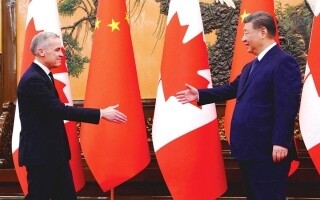
Amidst the rivalry between two global powers, the United States and China, seeking to redraw the international system's contours, cooperation among what are known as middle powers is increasing across various domains, such as trade and security. This approach is an attempt by these nations to safeguard their interests and ensure they do not become 'victims' of the emerging new global order. Canadian Prime Minister Mark Carney has emerged as one of the most prominent advocates for enhancing cooperation among a wide array of countries, including Canada, most European nations, Japan, South Korea, Australia, India, Brazil, Turkey, and others. During his participation at the World Economic Forum in Davos, Carney stressed the importance of this direction, stating: 'Middle powers must work together, because if we don't assert our presence on the international stage, we will become victims of the great powers.' The formation of the new global order is expected to cause significant confusion for many countries. On one hand, the United States is retreating from its traditional role as the leader of a rules- and law-based international order, appearing more inclined to use economic pressure and military force to compel other nations to comply with its demands. On the other hand, China is positioning itself as a rising global power with growing influence on the international stage. In this context, Eswar Prasad, an economist at Cornell University, noted that the rest of the world views these two options as undesirable, finding themselves caught in the middle without the genuine ability to fully align with either side. Middle powers are increasingly trying to protect themselves through two main paths. The first involves avoiding a drift towards dependence on great powers by enhancing self-reliance. The second path is building alliances with other middle powers on specific issues, such as supply chains, trade, and security cooperation, as confirmed by the German Aspen Institute. Vast regions of the world outside the US-China framework continue to seek new trade agreements, while many nations are increasing their military spending. Other countries, like France, are developing local alternatives to reduce American dominance in software and information technology. However, taking such steps is neither easy nor quickly achievable, as middle powers are not a cohesive bloc but encompass a wide diversity of countries in terms of interests, capabilities, and values. Due to this disparity, rising global turmoil can sometimes increase instability rather than contribute to enhancing international peace and security. Western nations have spent about 70 years building close trade and security ties with the United States, making the process of unraveling these links complex and costly. Currently, many countries have limited options but to try and avoid a devastating trade war or slide into dangerous security confrontations. In this vein, German Chancellor Friedrich Merz, speaking at the Davos forum, called for caution and not to hastily abandon the transatlantic partnership, saying: 'Despite all the frustration and anger we feel, we must not quickly give up on this partnership.' Germany has justifiable reasons for caution in rapidly distancing itself from the US; it is geographically close to Russia, lacks nuclear weapons, its economy is in a state of recession, and it is heavily dependent on exports. The choices are not straightforward in global trade either. The US has long been the engine of global demand, but it is currently trending towards self-isolation, which shrinks the opportunities for other countries to export their goods. Conversely, China does not represent an ideal alternative, given its focus on exporting goods to global markets more than importing from them. Under Carney's leadership, Canada has moved towards greater alignment in its trade policy with China and has also rushed to implement projects in oil, gas, and mining to bolster its economic independence. It has also expanded its export port capacities to reduce reliance on the American market. Meanwhile, the European Union has been swift in negotiating free trade agreements with India and the South American Mercosur bloc, and is also seeking to finalize a similar deal with Australia. In this context, EU Trade Commissioner Maroš Šefčović affirmed that the Union is making a clear strategic choice, stating: 'We are deliberately choosing openness over protectionism, cooperation over fragmentation, and rules-based trade over unpredictability.'