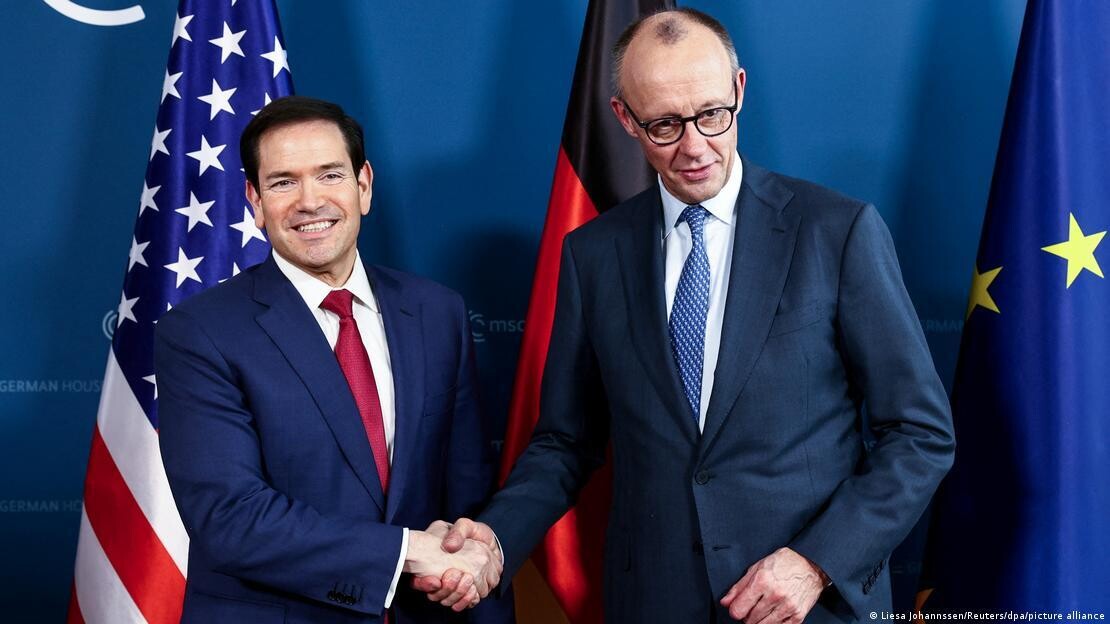
The scene was closely followed by diplomats assessing Germany's ability to build consensus with France and the UK during a period of redefinition. Known European reactions to the speech reflected a mix of relief and caution. In this climate, the American message was seen as an attempt at political realignment after months of friction, but with more explicit conditions on migration, spending, and the rules of the game. In parallel, Rubio maintained contacts with European leaders, including German Chancellor Friedrich Merz, in a gesture aimed at sustaining a direct channel with Berlin in discussions about the future of European security architecture. In Munich, this interpretation received a mixed reception: while some interlocutors valued the emphasis on reforms, others warned that weakening multilateralism could worsen the global governance vacuum. Rubio's intervention also took place against a backdrop of Europe's search for greater strategic autonomy and the debate on the direction of continental security in Russia's war against Ukraine. This stance aligned with a more skeptical view of post-war multilateral institutions and the idea that effective leadership lies in specific alliances and the ability of powers to execute decisions on the ground. For European governments, the challenge will be to translate this rhetoric into concrete agreements without deepening internal divisions or sacrificing the political balances that the European Union faces on immigration, the economy, and security. The proposal, interpreted by European delegations as a signal that Washington seeks to reorder economic and commercial priorities based on national security and reindustrialization, was framed within a broader debate on supply chains, energy dependence, and technological competition. Another key axis was the criticism of the UN. Rubio asserted that in 'most of the most urgent matters,' the organization 'has no answers' and 'has practically had no role.' In this argument, he emphasized a 'spiritual and cultural' connection between both sides of the Atlantic, supported by language, Christianity, and the European origin of millions of Americans—a passage aimed at recovering a narrative of a civilizational community amid tensions over trade, defense, and migration. However, the harshest part of the message focused on immigration. Rubio described 'massive immigration' as a crisis that 'transforms and destabilizes' Western societies, and defended that 'regaining control of the borders' is not xenophobia but 'a fundamental exercise of sovereignty.' Some prominent figures highlighted the tone of unity and the reaffirmation of the historical bond with Europe, while others emphasized that the continent will continue to deepen its strategic independence beyond transatlantic rhetoric. In this line, he indicated that Washington prefers to act 'alongside its European friends,' though he made it clear that he considers it possible to advance alone if the context requires it. The head of US diplomacy insisted that a weakened Europe ultimately affects the United States, and argued that the strength of the alliance is not a diplomatic gesture but a central component of shared security. The point of convergence, in any case, was the signal that Washington wants to reorder priorities and update institutions, and that the discussion is no longer just about 'being together,' but about under what rules, with what costs, and facing what threats. With the project of a 'revitalized alliance,' Rubio left in Munich a political roadmap: close cooperation, but framed in border sovereignty, review of climate policies, and a critical view of multilateralism. 'We are not looking to separate, but to strengthen an old friendship' and 'renew the greatest civilization in human history,' Rubio stated, presenting the United States as a partner interested in a strong Europe. The choice of this formulation sought to shield the position from criticism from European sectors that associate the hardening of migration policies with the advance of identity and right-wing discourses, in a context of internal pressures on governments over social integration, security, and public services. The Secretary of State also targeted climate policies that, he claimed, have contributed to impoverishing Western peoples, and questioned what he defined as the 'madness' of free trade that would have deindustrialized Europe and the United States 'to the benefit of rivals and adversaries.' On the sidelines of the forum, European officials stressed that the link with the United States remains essential, although they underscored that the continent intends to increase its own capabilities in defense and industry.