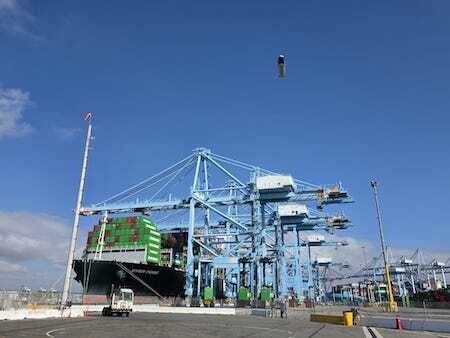
The scene is set at the Pier 400 port complex in Los Angeles–Long Beach, one of the largest on the West Coast of the United States, a place where the movement never stops and where automation has ceased to be a project to become part of the daily routine. Competition is no longer measured in days but in minutes. López notes that automation has also changed the profile of the workforce. López acknowledges that the biggest challenge is not the technology, which advances faster than it can be installed, but the availability of energy. Robots that charge themselves, cranes that prevent collisions using algorithms, trains that form in record time, and electric equipment replacing combustion engines in a sprint to 2030. Implicitly, the tour makes it clear that the port already operates on a different logic: one where efficiency, technology, and sustainability are on the same level. California requires that by 2030 terminals have zero emissions, and López points out that three fully electric machines are already in operation, in addition to tractors, top loaders, and other hybrid equipment in the process of transition. That is why they work with the state's electric company to plan demand for 2027, 2028, and 2029, when the transition will be more intense. As the tour progresses, it is evident that this terminal serves as a showcase for what port operations will be like in the next decade. Advanced algorithms organize the flow, anticipate movements, and assign routes to maintain the times the industry demands. From the dock, cranes follow routes calculated by a central system that manages security, time, and distances. And the goal is not just to move more containers, but to do so more safely, more cleanly, and faster than any other entry point on the West Coast of the United States. Today, with automated systems and yard robots working as a seamless gear, it has reached 1.9 million, a 30% increase. This leap allows it to handle ships of up to 24,000 TEU and sustain operations with 97% occupancy without service degradation, something uncommon in complexes of this scale. In 2024, the Port of Los Angeles handled about 6.7 million TEU (twenty-foot equivalent units) of international trade, representing 17% of the total container trade in the U.S. Previously, in its conventional version, it reached a capacity of 1.4 million movements. This change not only increases efficiency but also redefines the type of port job that predominates on the West Coast. Another essential piece of the gear is the railway operation. A few meters away, the robots—automated straddle carriers—move without human intervention, moving containers between the ship, the yard, and the train with a precision that surprises even those familiar with port operations, in boxes that can contain anything from avocados to industrial materials crossing the Pacific every week. Eduardo López, Operations Director of APM Terminals Los Angeles Pier 400, explains that the entire process seeks one principle: to separate man from machine to ensure safety while simultaneously increasing capacity and operational efficiency. "We are the safest terminal to work on the entire West Coast of the United States for the last two years," he says, pointing to the machines operating autonomously while maintaining the Asia–U.S. trade route. "Our employees have developed new skills to handle this type of equipment," he explains. Combining Los Angeles + Long Beach, they handle approximately 31% of all containerized trade in the U.S. Part of this movement is managed within Pier 400's control room, where decisions that once depended on dozens of dispersed operators are made. In some cases, a container unloaded at dawn can be available 90 minutes to two hours later, especially when it comes to urgent cargo from Asia, in a constant rhythm. Automation has not only transformed the dock; it has also changed what the terminal can move. Collaboration with the union was key to training the staff in technological skills and preparing them for a more complex operation. The challenge now is to scale: by 2030, they still need to electrify the remaining 30%, mainly the autonomous yard robots. The project also incorporates self-generation solar power to add energy to less intensive operations, LED lighting, efficient air conditioning, and the use of ultra-low sulfur diesel when no electric alternative exists. Sustainability has become a regulatory and operational axis. The system includes medium-voltage automatic chargers that allow recharging batteries in three to five minutes. The average time to form trains remains below the national standard: about three days compared to the usual four. That speed maintains the competitiveness of the corridor and avoids bottlenecks in times of high demand. But the transformation does not end with productivity. Between 25% and 30% of the cargo is shipped by rail, connecting directly with hubs such as Chicago, Memphis, or Kansas City.