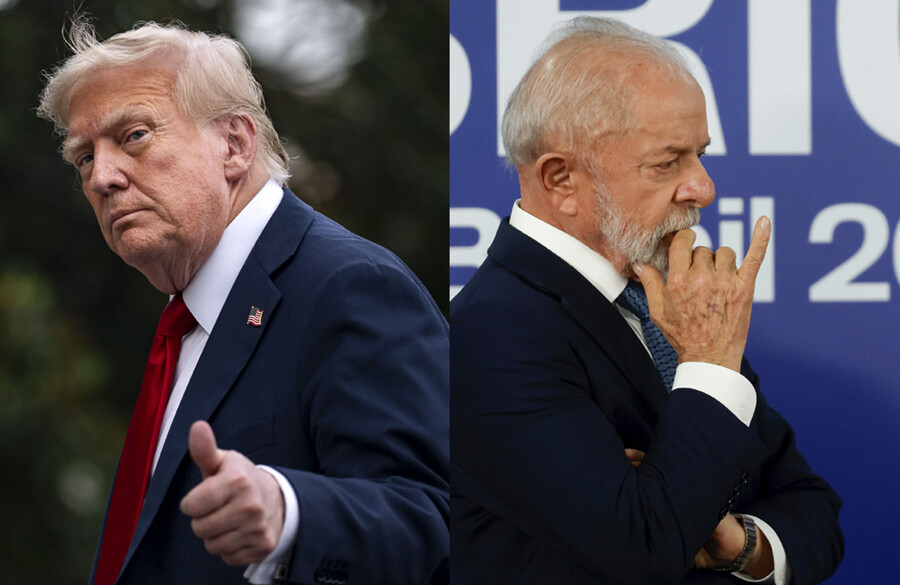
The president of the United States, Donald Trump, withdrew this Thursday the 40% tariffs on certain products from Brazil, such as beef, vegetables, coffee, and cocoa, after negotiating with his Brazilian counterpart, Luiz Inácio Lula da Silva. As part of his trade war, Trump had imposed a 10% tariff on Brazilian exports, to which he later applied another 40%, raising the total to 50%, in retaliation for the trial against former President Jair Bolsonaro, an ally of the American leader who was sentenced to 27 years in prison for attempting a coup d'état following Lula's electoral victory. The new executive order, signed by Trump this Tuesday, removes tariffs on certain goods that were imported from Brazil or withdrawn from warehouses since last November 13. The exemptions are included in two lists that range from meat and other beef products to spices, fruits, and grains such as coffee, cocoa and their derivatives, and many other agricultural goods. Fossil fuels, products or substances related to coal and its processing, liquefied gases, chemicals, wood pulps, and countless components for civil aviation are also included. Trump and Lula, who promised to defend his country's sovereignty, began to negotiate after running into each other in the corridors of the UN General Assembly in September in New York, a moment when, according to the leaders, a 'chemistry' arose between them. The leaders soon had a phone call and met face-to-face on October 26 in Kuala Lumpur (Malaysia), in an encounter described as positive by both sides. Since then, teams from both Governments have discussed the possible revision of the tariffs imposed on Brazil, a country that, according to official data, has had a trade deficit with the North American country for the last fifteen years. Last week, the Brazilian Government described as 'positive' Trump's plan to remove certain tariffs on Brazilian agricultural products, but said it hopes to continue negotiating new reductions. The president of Brazil, Luiz Inácio Lula da Silva, expressed this Thursday his happiness after his American counterpart, Donald Trump, eliminated the extra 40% tariff on various Brazilian products. 'Today I am happy because President Trump has already started to reduce some of the tariffs he had applied to certain Brazilian products,' affirmed the progressive leader during his speech at the inauguration of the São Paulo International Auto Show. The head of state showed pride in not having responded in hot-headed fashion when last July Trump decided to impose an additional tariff of up to 50% on most Brazilian imports for mainly political reasons. 'When the president of the United States decided to impose super tariffs on the entire world, everyone went into crisis and got nervous,' but 'I usually don't make decisions when I have a 39-degree fever, I wait for it to go down,' Lula explained. In turn, the Brazilian Ministry of Foreign Affairs reiterated in a note its willingness to 'continue dialogue as a means of solving the differences between the two countries,' in line with the 201 years of 'excellent' diplomatic relations. 'Brazil will continue to negotiate with the United States with a view to the withdrawal of additional tariffs on the rest of the bilateral trade agenda,' assured the Foreign Office. The Republican leader decided at the time to tax a large part of Brazilian imports in retaliation mainly for the trial that led to the former far-right president Jair Bolsonaro to be sentenced to 27 years in prison for attempting a coup d'état. This fact led to the two largest democracies in America to an unprecedented diplomatic and commercial crisis, also encouraged by one of Bolsonaro's sons, deputy Eduardo, who met with White House representatives to promote sanctions against his country. However, tensions have been considerably reduced since Lula and Trump met last September in the corridors of the United Nations General Assembly in New York, where an 'excellent chemistry' emerged between the two leaders. That first contact was followed by a phone call and, finally, a face-to-face meeting on October 26 in Kuala Lumpur, in which they agreed to formally begin negotiations on the bilateral trade agenda, which had been blocked until then. Trump and Lula also agreed to make official visits to Brasilia and Washington, respectively, in the future. 'Things happen to the extent that we earn people's respect. In politics and in economics there is no magic. Nobody respects whoever does not respect himself,' Lula stated.