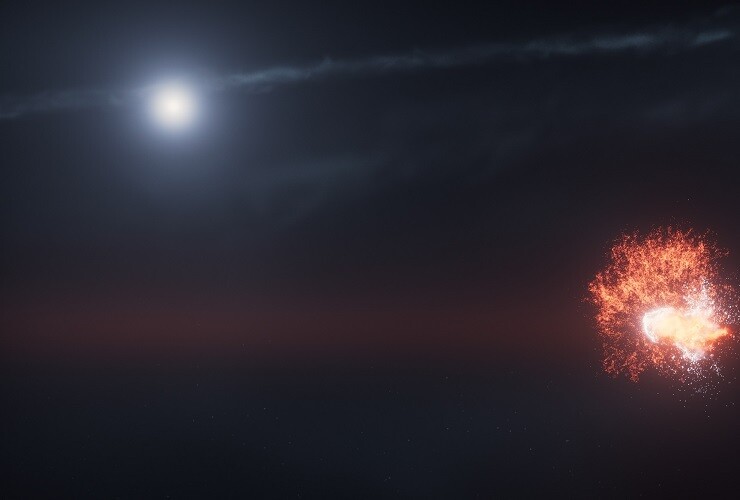
An international team of astrophysicists, led by the University of California, Berkeley, has made a discovery published in the journal Science. The team observed the aftermath of two powerful collisions (in 2004 and 2023) around the nearby star Fomalhaut. These observations suggest that such collisions may be more frequent than previously thought.
"We just witnessed the collision of two planetesimals and the dust cloud that arises from that violent event and begins to reflect the light of the host star," said Paul Kalas, an astronomer at Berkeley and the study's lead author. Although they did not see the impact directly, they can detect its aftermath because the dust around Fomalhaut will 'shine' like Christmas lights for tens of thousands of years.
Theory suggests that large collisions are infrequent, happening once every 100,000 years or more. However, in twenty years, astronomers have observed two such events. Based on the brightness of the 2004 and 2023 events, astronomers calculated that the colliding objects were at least 60 kilometers in diameter, four times larger than the asteroid that wiped out the Earth's dinosaurs 66 million years ago.
In 1998, using the Hubble Space Telescope, astronomers found a dust disk around the star Fomalhaut. In 2008, they discovered a bright object, which they named Fomalhaut b. However, in 2023, this object was gone, and in its place appeared another bright light source (Fomalhaut cs2). These observations support the hypothesis that neither was a planet, but rather dusty remnants from dramatic collisions between planetesimals, the building blocks of planets.
"The Fomalhaut system is a natural laboratory for investigating how planetesimals behave when they collide," said Mark Wyatt, a co-author from the University of Cambridge. "This allows us to know what they are made of and how they formed."
In the coming years, Kalas will use the James Webb Space Telescope's Near-Infrared Camera (NIRCam) to observe Fomalhaut and track the evolution of the dust cloud to determine its orbit. "In a sense, it is like looking back in time, to that violent period of our solar system when it was less than a billion years old," Kalas added.