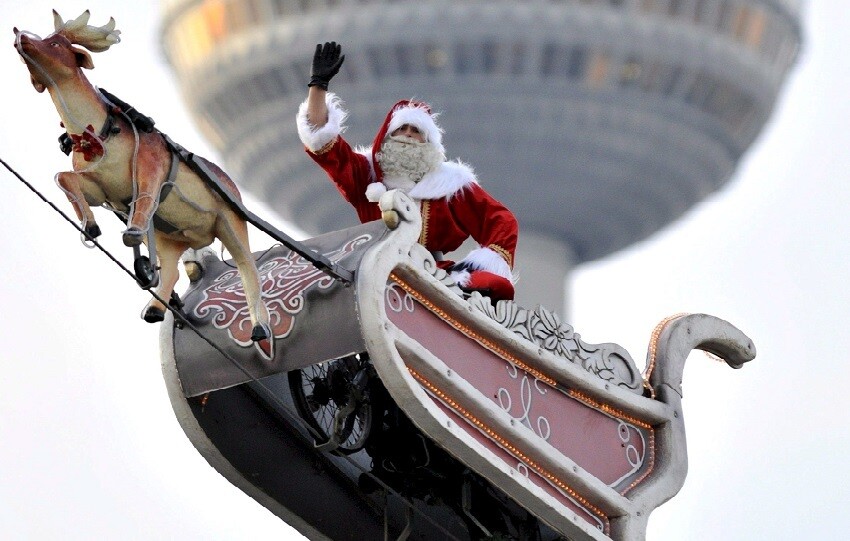
As on every Christmas Eve, the armies of the United States and Canada activated a joint search this Wednesday to track Santa Claus's sleigh, a Christmas tradition that is now 70 years old and originated from a curious error during the Cold War.
It was December 1955 when the red phone unexpectedly rang in the bunker of the then Continental United States Air Defense Command (Conad) in Colorado. When Colonel Harry Shoup picked up, he did not receive an alert about an imminent nuclear attack, but the voice of a child asking with total innocence: "Is Santa Claus there?".
The response was blunt: "Santa Claus only delivers gifts to children who are asleep".
The tradition is so deeply rooted that the President of the United States, Donald Trump, plans to join the volunteers and take calls with children from all over the country, as some of his predecessors have done.
Military technology at the service of magic
Norad assures that to locate Santa's sleigh, it uses the same systems it employs in its usual operations, including the North Warning System, a network of long-range radars that covers northern Canada and Alaska and allows the sleigh to be detected as soon as it takes off from the North Pole. To this is added infrared satellite detection, capable of identifying Rudolph the reindeer's nose, which emits a heat signal comparable to that of a missile, as well as visual confirmations from fighter jets when Santa enters North American airspace.
Despite this tracking, Santa has full authorization to traverse the skies. The Pentagon reminded of this in 2024, amid the collective hysteria caused by a wave of strange drone sightings in New Jersey. The authorities then asked the public that, before alerting the FBI, check if what they were seeing was simply Santa's sleigh. "Be aware that it is an authorized flying object," stated the Department of Defense.
Far from breaking the illusion, Shoup played along with a "Ho, ho, ho".
The origin of this misunderstanding dates back to an advertisement by the department store Sears in a local Colorado newspaper, which invited children to call Santa Claus, but the number that appeared was that of Conad by mistake. During that Christmas, Shoup received hundreds of calls from children and decided to organize a volunteer center so that the youngest could call to find out about the whereabouts of Santa Claus and his reinow-pulled sleigh.
The tradition in the digital age n Seven decades later, the North American Aerospace Defense Command (Norad), heir to the former Conad, continues the tradition and tracks Santa Claus's steps every Christmas Eve, who first visits New Zealand and Australia, where night falls earlier, and then continues through Asia, Africa, and Europe to finish in America.
So that the little ones at home can follow his route in real time, Norad enables each year the website www.noradsanta.org with a map where you can see Santa and his reindeer jumping from country to country. The site, available in nine languages—English, Spanish, German, French, Italian, Portuguese, Chinese, Japanese, and Korean—also indicates how many minutes are left for the stop and includes a counter with the millions of gifts distributed.
Children can also call Norad by phone, where about 1,000 American and Canadian volunteers answer their questions about Santa Claus's location and origins. Last year, around 380,000 calls rang at the Peterson base in the city of Colorado Springs, Norad's headquarters.
One of the most frequent questions is what happens if children are awake when Santa arrives. "If you see red and green lights in the sky, it is probably him."