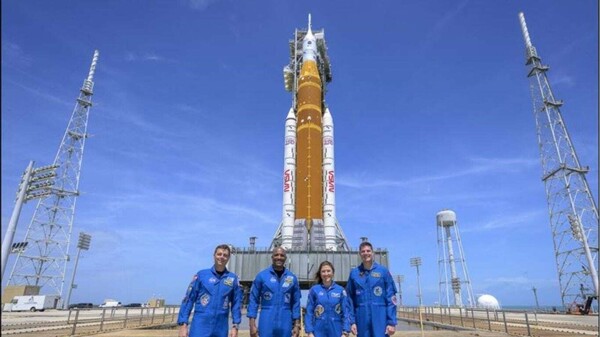
The Americans who paved the way to the Moon more than half a century ago were white men chosen for their experience as military test pilots. This first trip for Artemis II includes a woman, a person of color, and a Canadian. The four astronauts of the Artemis II mission, which will make NASA's giant leap for the Moon, look very little like those of the Apollo era. None of them had even been born during NASA's famous Apollo program, which sent 24 astronauts to the Moon, including 12 moonwalkers. This time, they will not land on the satellite or even orbit it, but the round trip will take them thousands of kilometers deeper into space than the Apollo astronauts ventured, and promises unprecedented views of the far side of the moon.
"Christina Koch, the first woman to travel to the Moon"
The last time Christina Koch blasted off into space, she stayed out for nearly a year. That's why she isn't worried about a much shorter round trip to the Moon. The 47-year-old electrical engineer from Jacksonville, North Carolina, holds the record for the longest single spaceflight by a woman, with a total of 328 days. During that long stay on the International Space Station in 2019, she also participated in the first all-female spacewalk.
Beyond her individual achievements, Koch emphasizes the collective significance of her upcoming mission: "It's about celebrating that we've reached a point in history where women can fly to the Moon." Before being selected by NASA, she spent a year at a research station in the South Pole. Her dog, rescued with her husband, is named Sadie Lou.
The Artemis II mission astronauts have experienced several delays in recent months due to technical and safety reviews, especially on the Orion spacecraft systems and other program components. These adjustments led NASA to delay the initial schedule to ensure flight reliability. Nevertheless, the astronauts agree that these delays have strengthened their preparation. In that sense, she explained that Artemis II represents a fundamental step to pave the way for the moon landing planned in Artemis III.
"It's not going to be as long as the last time," she commented. Koch highlighted the motivating effect of the Artemis program's advances and the future exploration of Mars: "It has been inspiring and has propelled us even further." Likewise, she emphasized the collective nature of the mission, comparing it to "a relay race, in which we only succeed if the following missions also succeed."
Between that experience and her time in space, she jokes that she has "immunized" her family and friends against her long absences. "So far, I haven't noticed too much nervousness in people. Maybe my dog, but I've calmed her down by telling her it's only 10 days."