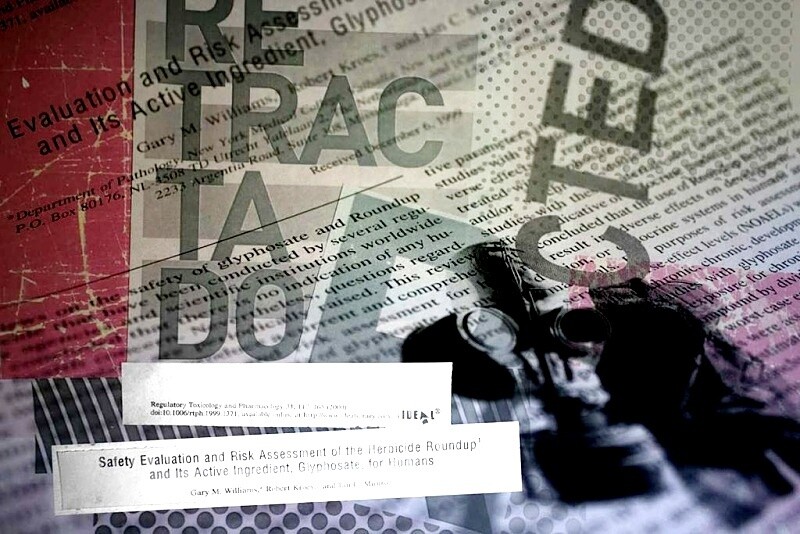
There is no doubt that they should be banned. Source: https://agenciatierraviva.com.ar/el-fraude-del-agronegocio-revista-cientifica-confirma-que-monsanto-mintio-con-el-glifosato/ In these processes, thousands of Monsanto documents were revealed to hide or falsify information and manipulate scientists and journalists to defend glyphosate. Illustration: Sebastián Damen Bayer has already paid more than $12 billion in judgments and settlements with about 100,000 cases, but they continue to increase, so the company asked Trump to intervene with the Supreme Court of that country to not allow the lawsuits to continue. Glyphosate is under use restrictions in two dozen states or countries, but the sale of this toxic is a big business, linked to transgenic crops and those of so-called "gene editing," which is why companies invest aggressively in its defense. While new data continues to be revealed about the manipulation of information by Monsanto-Bayer and other companies to deceive the public and regulators, evidence of the serious harm this and other agrochemicals cause to human, animal health, and the environment also continues to grow. In a historic decision, the journal that published that paper now recognizes that it was paid for by Monsanto (today Bayer), the main producer of the agrochemical. Silence from governments, producers, academics, and agribusiness journalists. By Silvia Ribeiro for La Jornada. The scientific publisher Elsevier publicly retracted one of the most cited studies on the herbicide glyphosate, which claimed there is no evidence that it is harmful to human health. They found that the study had numerous flaws and that it was actually written by "scientists" from Monsanto (now owned by Bayer) and not by those who signed as authors, who also received a payment from the multinational for the article to appear as independent of it. This is a highly relevant fact because the discredited article is one of the most cited by regulatory agencies in Europe, the United States, and Latin America, which based their arguments on it to claim there is no evidence of serious harm to health from glyphosate. The journal's action was motivated by another scientific study, published this year, which denounced the irregularities. Photo: Tierra Viva In this quarter of a century, tens of millions of people worldwide have suffered the impacts and damages of glyphosate, especially those in areas where transgenic crops are planted on a large scale, such as Argentina, Brazil, and Paraguay, where many people, even girls and children, have died from its effects, despite multiple complaints about the impacts of glyphosate spraying. The fact that Monsanto wrote the article and paid the listed authors first appeared as evidence in 2017 in one of the trials against Bayer-Monsanto for causing cancer in plaintiffs. In that instance, emails from Monsanto executives were shown, where they congratulated themselves on the success of the now-retracted article, including Hugh Grant, then global president of the company, for the well-forged article. This way of acting, with "ghostwriters" who deny evidence and hidden payments to scientists so they are not linked to the company, is part of the strategy that Monsanto called internally "Freedom to operate" to advance the sale of toxic products with impunity. After the WHO declared glyphosate a possible carcinogen in 2015, a flood of cancer victims who had used or been exposed to glyphosate in the US emerged, with more than 167,000 lawsuits to date. In summary, explains the journal's director, Martin van den Berg, the article presents "serious ethical problems" due to the concealment of evidence, the lack of integrity, and the conflict of interest of the authors, which leads to questioning the conclusions of the same. The big question is why it took 25 years since the publication of this fraudulent article for it to finally be retracted. Illustration: Sebastián Damen A "scientific" work was (and is) taken as a reference for decades by defenders of glyphosate. The journal stated that evidence of the poison's impact was omitted and withdrew the paper from its site for "serious ethical problems." This despite the fact that the World Health Organization (WHO) in 2015 and numerous scientific studies before and after have confirmed the short and long-term toxicity and the potential to cause cancer of this herbicide. Glyphosate is the most used agrochemical in the world, which has left toxic residues in food, bodies, water, the environment, and even traces have been found in air and clouds due to its high degree of dissemination. Photo: Depositphotos The journal Regulatory Toxicology and Pharmacology details in the argument for retracting the article, originally published in the year 2000, that the authors Williams, Kroes, and Munro did not take into account an extensive list of peer-reviewed and published articles before that date, which show evidence of the toxicity and carcinogenicity of glyphosate and its derivatives.