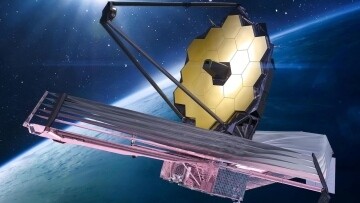
Scientists have used the James Webb Space Telescope to create the most detailed cosmic map to date of dark matter, the mysterious substance that makes up most of the stuff in the universe. "This allows us to resolve finer dark matter structures, detect mass concentrations that were previously unseen, and extend dark-matter mapping into earlier epochs of the universe," said observational cosmologist Diana Scognamiglio of NASA's Jet Propulsion Laboratory in California, lead author of the research published on Monday in the journal Nature Astronomy. The map reveals with unprecedented clarity new details of the macrostructure of the universe called the cosmic web—galaxy clusters, immense filaments built of dark matter along which galaxies and gas are distributed, as well as regions with less density of mass. Webb, an infrared telescope possessing about six times the light-gathering power of Hubble, was launched in 2021 and became operational in 2022. Using observations from the James Webb Space Telescope in a patch of the sky covering almost three times the area of the full moon, scientists have created the most detailed cosmic map to date of the mysterious substance called dark matter that accounts for most of the stuff that populates the universe. Ordinary matter makes up stars, planets, people, and everything else we can see. The rest is dark matter, which does not emit or reflect light, making it invisible to the human eye and to telescopes. Scientists infer its existence based on the gravitational effects it exerts on a large scale, such as how quickly galaxies rotate, how galaxy clusters are held together, and how light from distant objects bends as it passes through massive cosmic structures. The new map of the distribution of dark matter was based on this phenomenon of light bending—causing subtle distortions in the shape of roughly 250,000 distant galaxies as observed by Webb—thanks to the gravitational effects of matter along the line of sight. A previous map of dark matter was based on observations by the Hubble Space Telescope. "It sees fainter and more distant galaxies with much sharper detail than ever before. That effectively gives us a much denser grid of background galaxies to work with, which is exactly what you want for this kind of study," Scognamiglio said. The map covers a part of the sky called the Cosmic Evolution Survey, or COSMOS, located in the direction of the constellation Sextans. "The James Webb Space Telescope is like putting on a new pair of glasses for the universe," Scognamiglio said. The map will facilitate future investigations of the universe in numerous ways, the researchers said. The new map, powered by Webb's greater capabilities, offers double the resolution of the previous map, spans more parts of the cosmos, and peers further back in time—effectively looking to roughly 8 to 10 billion years ago, a key period for galaxy formation. But it represents only about 15 percent of all the matter in the cosmos.