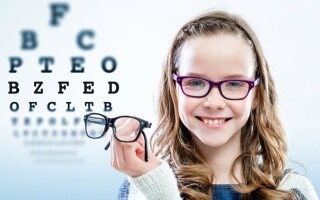
A US study has shown that some common daily household habits can play a key role in the development of myopia in children and young people. Researchers from the State University of New York explained that the cause of myopia is not limited to screens alone, as was previously thought, but is linked to complex factors that include how the eyes are used and indoor lighting. The results were published on Tuesday in the journal 'Cell Reports'. Myopia, known as a visual disorder that makes distant objects appear blurry while near vision remains relatively clear, is one of the most common vision problems globally. It has become a global epidemic, affecting about 50% of young people in the Americas and Europe, and up to 90% in parts of East Asia. The global increase in myopia rates has long been attributed to rising screen time, especially among children and young people. However, the new study suggests the cause is broader and more complex, linked to common daily visual habits at home. According to the study, these habits include reading and writing for long periods in dim light, using phones, tablets, or computers from short distances for hours, and engaging in fine manual activities that require close visual focus in low light. The researchers found that prolonged focus on close objects in low-light environments reduces the amount of light reaching the retina, which can weaken retinal activity and accelerate the progression of myopia. The new hypothesis is that the common factor among most causes of myopia is the amount of light reaching the retina during visual activities that require focusing on close objects for extended periods. When focusing on close objects, the pupil constricts to improve image clarity, and the eyes converge to align vision. If this occurs in low light, pupil constriction reduces the light reaching the retina, increasing the likelihood of retinal weakening and gradual myopia development. In bright light, pupil constriction is regulated by light intensity rather than distance, allowing sufficient light to reach the retina and protect against myopia progression. The researchers recommended modifying some household habits to reduce the risk of myopia, including improving lighting during reading or device use, taking regular breaks when using phones, tablets, or computers, increasing time spent outdoors looking at distant objects, and maintaining an appropriate distance between the eyes and devices or books. The team noted that these findings are not a definitive answer but a testable scientific hypothesis based on precise physiological measurements linking visual habits, lighting, and eye function. The researchers hope this new perspective will open the door to a deeper understanding of the reasons for myopia's spread and contribute to establishing a scientific basis for its prevention in the future.