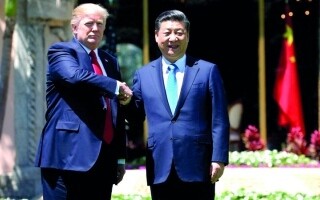
Conducting more flight tests to keep up with Russian and Chinese measures could undermine this progress. On his way to meet with Chinese President Xi Jinping for trade negotiations, U.S. President Donald Trump posted a brief statement on October 29 that seemed to indicate the U.S. would soon resume nuclear testing. Trump wrote on Truth Social: "Due to the testing programs of other countries, I have instructed the Department of Defense to begin testing our nuclear weapons on a like-for-like basis. This process will start immediately." What Trump meant by this is unclear at best, and his Energy Secretary opposed it, further clouding the situation. While some assumed this was a direct order to resume nuclear testing, the phrase that the U.S. would conduct tests "on a like-for-like basis" suggests it is more about testing delivery systems or conducting tests with very low-yield materials and components, not the warheads themselves. The U.S. President said he had begun testing "on a like-for-like basis," but neither China nor Russia has conducted large-scale nuclear tests since they signed the Comprehensive Nuclear-Test-Ban Treaty (CTBT). However, there are claims that they may be conducting small "sub-critical" nuclear tests, which means achieving a sustainable chain reaction. Trump appeared to refer to these claims in an interview with "60 Minutes" that aired last week. Such tests could theoretically be conducted on a narrow enough scale to avoid detection, and tracking them through intelligence is extremely difficult. Furthermore, narrow-spectrum "sub-critical" tests yield less information than full-scale warhead tests, as a full-scale nuclear explosion does not allow for the direct testing of the interaction of different materials within a nuclear warhead. These tests also require specialized facilities that the U.S. has not invested in, and conducting them could take years of investment. The U.S. is currently updating its existing "sub-critical" test facility, officially known as U1a, at a cost of about $2.5 billion, and it may not be ready until 2030. Significant drawbacks Trump's announcement also came at a time when Russia was testing two next-generation nuclear weapon delivery systems: "Burevestnik," a nuclear-powered cruise missile with some questionable technical features, and "Poseidon," a nuclear torpedo designed to destroy coastal cities. Trump may want the U.S. to begin testing nuclear systems at a pace that matches the testing pace in China and Russia. However, resuming nuclear tests and increasing flight tests could have significant drawbacks. For one, it is unclear how quickly the U.S. could resume nuclear testing. Formally, the U.S. retains the ability to resume testing within 24-36 months of a presidential decision, but the realism of this timeline is unclear. The Nevada nuclear test site is in poor condition and would likely require significant resource investments. Additionally, conducting large-scale nuclear tests would not yield great benefits and would mean abandoning commitments under the CTBT. Other signatory countries, such as Russia and China, could follow suit. China would benefit the most from the technical data of a resumption of testing, as its current data is limited. Before the CTBT, China conducted only 45 nuclear tests, while the U.S. conducted over 1,000. Resuming nuclear tests could also lead to dangerous diplomatic consequences amid growing public discontent in allied countries. For nearly a decade, the U.S. has tried to maintain its reputation on nuclear issues, while other countries have questioned the slow progress in nuclear disarmament. Despite commitments under Article 6 of the Treaty on the Non-Proliferation of Nuclear Weapons (NPT) to continue negotiations in good faith on disarmament, progress in nuclear disarmament has slowed over the past decade, with Russia, China, and the U.S. investing in new weapon systems. Wide popularity Meanwhile, some countries have lost patience due to the lack of progress and have supported a stricter Treaty on the Prohibition of Nuclear Weapons, which prohibits signatory states from producing, transferring, or allowing the storage of nuclear weapons on their territory. The Treaty on the Prohibition of Nuclear Weapons has been signed by 95 countries and is widely popular in U.S. allied countries, including Australia, Japan, and the Netherlands. Resuming nuclear tests could also spark public outrage in these countries and make it politically unacceptable to resist signing the Treaty on the Prohibition of Nuclear Weapons. This would have dire consequences for the network of alliances the U.S. has built to deter Russia and China. For example, the U.S. is currently developing nuclear weapons designed to be deployed on attack submarines. If countries like Australia and Japan were to sign the Treaty on the Prohibition of Nuclear Weapons, they would be prohibited from hosting nuclear weapons on their territory and would demand that the U.S. declare that visiting attack submarines do not carry nuclear weapons. But the U.S. follows a strict policy of not disclosing the presence of nuclear weapons anywhere. Previous attempts by New Zealand to force U.S. warships visiting its ports to declare nuclear weapons led the U.S. to suspend its defense commitments to New Zealand. A similar situation could arise in other allied countries if they were to join the Treaty on the Prohibition of Nuclear Weapons, creating serious problems for the U.S. alliance network and its ability to deter adversaries. From Foreign Policy Diligent efforts The U.S. has made diligent efforts to clarify that flight tests of systems with nuclear capabilities, such as regular tests of the Minuteman III intercontinental ballistic missile from Vandenberg Air Force Base in California, are part of routine testing and are not intended to send any message to adversaries. To mitigate tensions that missile tests might cause, the U.S. notifies other countries before conducting tests. China recently did the same after testing its intercontinental ballistic missile over the Pacific in September 2024. This is a praiseworthy step in risk reduction.