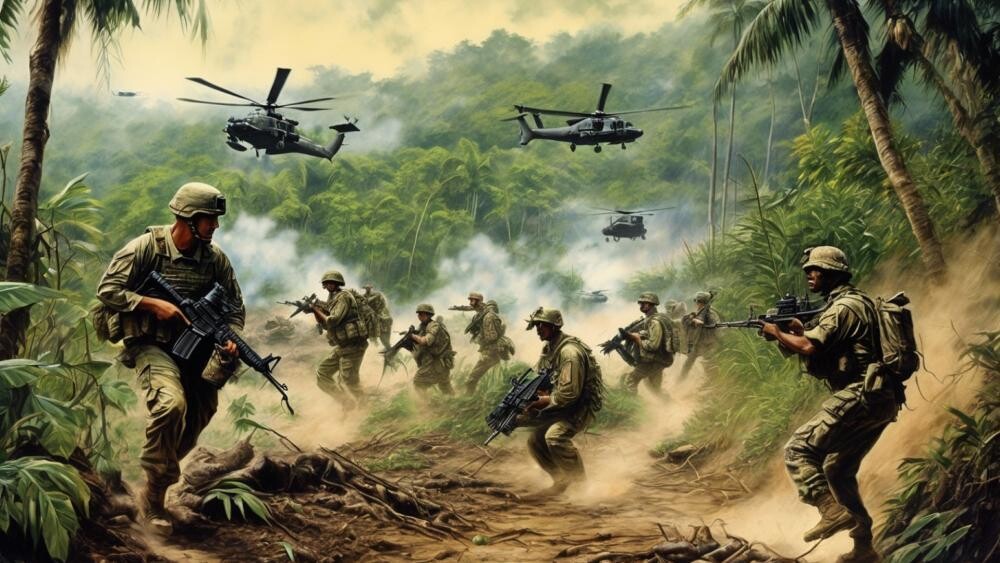
Memories of the 1989 Panama Invasion 'Just Cause' have resurfaced in recent weeks after Donald Trump ordered the largest US military buildup in Latin America and the Caribbean since that invasion almost four decades ago. The stealth bomber blitzkrieg and subsequent army ranger assault marked the start of the US invasion of Panama – Operation Just Cause – designed to dethrone Panama's military dictator, Manuel Noriega. Retired US Army pilot Michael Durant, pictured below, watched through night-vision goggles as two 2,000-pound laser-guided bombs slammed onto the Panamanian airbase while he hovered off the country's south coast in a Black Hawk helicopter. 'A gigantic flash, followed by a boom like the largest lightning strike you've ever seen in your life,' the retired pilot recalled of the opening salvo of the Battle of Rio Hato Airfield in December 1989. Durant and his colleagues had orders to capture the Panamanian Defense Force (PDF) base to stop troops coming to Noriega's rescue. Over the coming days, the pilot and more than 25,000 other American troops hunted the autocrat, who finally surrendered on 3 January 1990. 'Noriega was a bad, bad man ... and he needed to be removed,' said Durant, who considered Just Cause the most successful mission of his two-decade military career. However, he also expressed reservations about a potential invasion of Venezuela, citing the 2001 Afghanistan invasion as a 'cautionary tale' of how interventions sometimes veer off course. 'Even if Maduro was successfully toppled, that would not necessarily usher in a brighter future,' he noted. 'Sometimes you just remove one problem and replace it with another,' said Durant, highlighting how interventions can go awry. 'What happens the day after?' he asked. 'Are they capable? Are they willing to fight? Are they trained? Are they resourced? What can they really do? They do good parades.' But John Polga-Hecimovich, a Venezuela expert from the US Naval Academy, said Maduro's foes had been claiming 'his days were numbered' almost since he succeeded Hugo Chávez in 2013. Maduro has remained in power, thanks to a masterful strategy of regime 'coup proofing' which involved packing the military with Cuban and Venezuelan spies and using torture, purges, promotions and largesse to ensure loyalty, he said. Polga-Hecimovich feared a US intervention in Venezuela might also 'unleash a great deal of chaos' and provoke 'an enduring low-intensity conflict'. It was also unclear how capable Maduro's Bolivarian armed forces were of fighting back. 'That to me is the biggest wildcard,' Durant said. A seventh of US naval assets – including the world's largest aircraft carrier, the USS Gerald R Ford – have been sent to the region since August, with B-52 bombers and special forces spotted off Venezuela's northern coast. Airstrikes on alleged drug boats in the Pacific Ocean and Caribbean Sea have killed more than 60 people. Before Just Cause, thousands of US troops were stationed in Panama, Durant noted, but it has no such presence in Venezuela. In 1988, on the eve of Just Cause, the US indicted Noriega for drug smuggling – just as they have with Maduro who recently had a $50m bounty put on his head for allegedly running a 'narco-terrorist' cartel. 'Not to be the bearer of bad news, but it looks like we are about to embark on another regime change war, like, next week,' Tucker Carlson, pictured below, declared last week, flagging Iraq as a prime example of the US's ignominious track record of regime changes gone wrong. 'So ... they've established a convenient pretext if they choose to pursue a military route,' Grow said. Michael Grow, a historian who wrote a book about US presidents and Latin American cold war interventions, saw 'intriguing similarities' to past operations. He recalled how, from Washington's perspective, the 1954 Guatemala gambit had 'worked astonishingly well'. Operation PBSuccess – ordered by Dwight Eisenhower to extinguish a spurious communist threat – involved using a CIA-funded disinformation and sabotage campaign to convince Guatemalan military officials they were on the brink of being attacked by 'a powerful liberation army' and should abandon Árbenz to avoid 'devastating US retribution'. For the Central American country the CIA-sponsored coup was a disaster: Árbenz's resignation ushered in more than four decades of dictatorship and civil war during which more than 200,000 people were killed or disappeared. Eisenhower was said to be 'immensely pleased' and his CIA chief, Allen Dulles, 'exuberant'. But many observers, including Trump backers, question the wisdom of invading a country 12 times larger than Panama, and more politically and geographically complex. 'They're much more America First ... I just don't see the US getting involved in a land war in South America,' Grow added, although he did not rule out 'surgical strike drone warfare'. Durant hoped Trump's deployment was about intimidating Maduro and the military, not a prelude to invasion. He was certain US troops could overthrow Maduro, as they did Noriega. James Story, the US's top diplomat for Venezuela from 2018 to 2023, also doubted a Just Cause-style onslaught was coming: 'We always like overwhelming force and it would take 100,000 troops – and that's not Trump.' But the former ambassador – who initially considered Trump's military buildup sabre-rattling – now saw an 80% chance of 'some proactive action' on Venezuelan soil in the next 30 days, probably an airstrike. But many suspect Trump's real goal is toppling Venezuela's dictator, Nicolás Maduro, just as George HW Bush toppled Noriega before he was tried and jailed in the US. Some members of Venezuela's opposition appear keen for a replay of Just Cause, on an even greater scale. 'Send him into exile; send him to the US; or send him to meet his maker.' The US has spent years trying to break Maduro's regime, most memorably during Trump's first term when he recognized the opposition leader Juan Guaidó as Venezuela's rightful president. 'Árbenz was in effect deposed in a military coup produced by US intimidation and deception,' wrote Grow, who suspected something similar might be afoot with Venezuela, as Trump waged a war of nerves hoping 'the Venezuelan armed forces will take him out for us'. Last month Trump confirmed he had authorized covert CIA operations in Venezuela. 'I sure hope people are considering this.' People watch the USS Gravely departing Port of Spain in Trinidad for exercises off the coast of Venezuela. UH-60 Black Hawk helicopters stand by to evacuate wounded US military personnel during Operation Just Cause in Panama in 1989.