If the essence of the new security strategy adopted by the US President Donald Trump's administration could be summarized in one phrase, it would be: returning the United States to the status of a regional power after decades of playing the role of a global force. This document begins with a clear critique of a long course of American foreign policy that treated the United States as a dominant world power, seeking to protect its interests across continents, support globalization, rely on international institutions, and bear the burdens of the global system.
The document offers an alternative to this approach, based on the need for the United States to redefine its interests in a narrower and more specific way. Although the National Security Strategy recognizes important American interests in Europe and Asia, it emphasizes that the primary interest of the United States should be concentrated in its immediate geographical vicinity, i.e., in the Western Hemisphere.
In this context, the document is based on the "Monroe Doctrine," the policy announced by former US President James Monroe in 1823, which warned European powers against any new colonial attempts in the Western Hemisphere. It also refers to what is called the "Trump corollary," which closely resembles the "Roosevelt corollary" later announced by President Theodore Roosevelt.
Risks
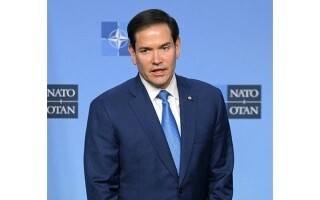
US Secretary of State Marco Rubio recently stated that the "America First" slogan means prioritizing the region where the United States lives and focusing on strengthening its interests and capabilities without being broadly engaged in world affairs.
At first glance, this approach seems logical, but the international reality makes its application fraught with risks. The United States today is the most powerful country in the world, and this power has grown over the past three decades, as its giant companies and advanced technologies have managed to extend their influence globally.
It is difficult, if not impossible, for a country of this stature to limit itself to monitoring what is happening in its regional surroundings without significant negative consequences, either for the country itself or for the international system as a whole, especially at a time when crises and conflicts are escalating.
Economic Interests
To understand this debate, it is necessary to return to the historical context in which the "Monroe Doctrine" emerged. At that time, the United States was a relatively small country, dependent on agriculture, with a population of about 10 million people, consisting of 24 states, most of which were located east of the Mississippi River. Its share of global GDP did not exceed 2.6%, which is roughly equivalent to a tenth of its current economic size. Moreover, its military power was extremely limited to the point that it was not among the top 15 countries in the world in terms of the number of armed forces.
In that context, Monroe recognized the independence of several Latin American countries that had recently freed themselves from Spanish and Portuguese colonialism, and therefore sought to warn the great European powers against intervening to re-colonize these countries. His doctrine was based primarily on the principle of rejecting colonialism and preventing foreign interference in the affairs of other nations.
Today, however, applying this perspective to contemporary United States seems unrealistic. The United States has become a great power with interests extending throughout the world, and therefore, concentrating its priorities in its regional surroundings means focusing on one of the least economically important regions in the world. The major trade and economic interests of Washington lie outside the Western Hemisphere, especially across the Atlantic and Pacific Oceans.
Discrepancy
The numbers illustrate the magnitude of this discrepancy in priorities. The volume of US trade with all Latin American countries, excluding Mexico, was about $450 billion in 2024.
In contrast, trade with the European Union exceeded $1.5 trillion, which is more than three times the trade with Latin America. Meanwhile, trade with Asia exceeded the two-trillion-dollar mark. While Canada and Mexico maintain close trade relations with the United States, the economies of these three countries are so interconnected that in some aspects they are more akin to a single North American economy.
When formulating the "containment" strategy that contributed to the United States' victory in the Cold War, American diplomat George Kennan believed that the world included six major centers of economic power: the United States, the United Kingdom, Germany, Western Europe, the then-Soviet Union, and Japan. He believed that Washington should ensure that the non-Soviet centers remained in positive relations with it.
Today, this list can be updated by adding China and merging Britain and Germany into a single European entity, but the essence of the strategy remains constant: maintaining strong relations with the centers of global economic gravity. However, the National Security Strategy adopted by the Trump administration seems to be tying the future of the United States to a marginal part of the global economy, ignoring this reality.
Foreign Policy
Here, a key observation emerges: the National Security Strategy document itself suffers from a lack of coherence, as it brings together sections that appear to have been written by different parties, often contradicting each other and relying on general and clichéd phrases.
President Trump's foreign policy is "pragmatic without being pragmatic, realistic without being realistic, principled without being idealistic, strong without being rigid, and disciplined without being peaceful." These descriptions remain vague and unclear. Despite some indications suggesting a limited readiness to play an international role, the general trend remains inclined toward retrenchment.
In essence, this vision differs little from the views of isolationists in the 1920s and 1930s, who called for staying out of European affairs and tightening immigration restrictions. During that period, as in the present, doubts about American engagement in world affairs were accompanied by rising anti-immigrant sentiment.
Back then, nationalists feared that immigrants would not be able to integrate into American society, so they imposed strict restrictions on their entry. These measures affected the Irish, Italians, Southern Europeans, and Jews—groups that history later proved had successfully integrated into American society.
Today, the National Security Strategy in the Trump era is obsessed with the issue of immigration, classifying it as a direct threat to national security and almost claiming that the most dangerous thing facing the United States and the Western world is immigration, whether to America or to Europe, warning that it could lead to the "erasure of civilization."
The Global System
The current international situation closely resembles that of the 1920s. The United States remains the only country capable of maintaining the stability of the global system, and therefore its withdrawal from the international stage, whether from its positive roles or even from crisis management, leaves dangerous vacuums that could be filled by other powers less capable or less committed to international responsibility than Washington.
About a century ago, the United States chose to retreat from its global responsibilities, the international system collapsed, and this was one of the factors that led to World War II and the immense destruction and heavy casualties that accompanied it.
Despite the existence of other international powers contributing to stability today, a US retreat and excessive focus on its internal affairs could leave the world without clear leadership and push it toward further disorder and chaos. Perhaps the hope remains that the world will not have to relearn this harsh lesson again.