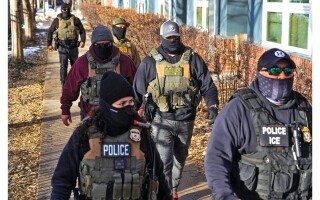
Minneapolis officials consider immigration enforcement measures necessary to prevent saboteurs from obstructing law enforcement. Among contemporary presidents, Trump stands out for his unique enthusiasm in escalating political tension when facing opposition. Whether this outcome was intended or not, the crackdown in Minneapolis may provoke an exaggerated reaction from the left, in the form of illegal local resistance and renewed calls from Democrats to 'abolish Immigration and Customs Enforcement' (ICE), just as some called to defund the police in 2020. Polls show that Trump's crackdown policy is unpopular now, but they also show that voters still trust Republicans in Congress more on immigration. Whoever the courts rule is breaking the law in Minneapolis, this competition is ultimately a political one, and the side that overreacts will lose, but there will be no real winner. Before knocking on the door, he sends a photo of himself wearing a red union cap to reassure families that he is not a federal agent. Catherine, who usually works in a hotel kitchen, after letting him in, said: 'They are everywhere.' She believes the political culture of Minnesota might help find an answer. Democratic Senator Amy Klobuchar explains: 'One of the things that might be unique here is that ordinary citizens, including a young woman, went to the scene of the incident (Renee Jean's killing) and started filming video.' She adds: 'When officers asked them to leave, they continued to film,' pointing out that Minneapolis shows a kind of 'immune response' to the spread of Immigration and Customs Enforcement. Solidarity and Resistance The policy of solidarity and resistance in Minneapolis stems from at least two sources, one old and one new. The hospitality season in Minneapolis, Minnesota, slows down due to severe cold gripping the Mississippi River; therefore, President Donald Trump's decision to send about 3,000 federal immigration officers to the city might seem, at least, a boost for hotels and restaurants. However, some people who clean rooms for officers or serve them food and drinks are themselves at risk of arrest in a strict campaign against immigrants in Minneapolis. For this reason, the local head of a union representing hospitality workers, Wed Lonnberg, had to distribute food to worker families hiding across Minneapolis. 'There is no safe place for us.' Questions One city resident, who runs a group to prevent violence, wonders: 'Why Minnesota? Why Minneapolis?' while watching a memorial erected at the spot where Renee Jean was shot by a U.S. Immigration and Customs Enforcement officer on January 7 of this year as she tried to flee in her car. The massive influx of immigrants of the type Trump said he didn't want more of is what created this left-leaning policy. The more recent source is the killing of George Floyd, which made even the city's most privileged residents realize how the law could be abused and rights stripped, says University of Minnesota law professor Emmanuel Maulion. He explained that there was what he called a 'collective awakening' to what happens when law enforcement goes too far, expressing his belief that the spirit of solidarity among residents was born in that moment. Necessity For Trump administration officials, the resistance of Minneapolis residents is itself illegal; they described Jean as a 'local terrorist' seeking to eliminate immigration officers. The state's Democratic Party is called the 'Democratic-Farmer-Labor Party' due to its roots in agricultural and labor circles in the early 20th century. Meanwhile, Democratic Senator Amy Klobuchar says: 'No one in our state can understand this.' This American was wondering what this incident has to do with the George Floyd memorial, whose death under a police officer's knee sparked local and global protests against police violence in 2020. Trump decided to send 3,000 federal immigration officers to the city.