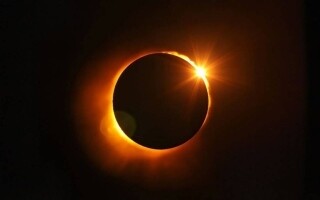
The world is set to witness the first solar eclipse of 2026 today, which has been dubbed a 'ring of fire' eclipse by a scientist at the U.S. space agency NASA, according to Pakistan's Geo News TV network. According to Dr. C. Alex Young, associate director for science communication at NASA's Goddard Space Flight Center's Solar Physics Laboratory in Greenbelt, Maryland, an eclipse occurs when "the Moon passes directly between the Earth and the Sun." Dr. Young added that the Moon will not be able to cover the Sun's disk completely because it is too far in its orbit, resulting in "a bright ring of sunlight surrounding the dark Moon's shadow, like a 'ring of fire.'" Young said the best location to view the ring of fire for the annular solar eclipse will be from the skies over the continent of Antarctica. He added that a partial eclipse will also be visible from the rest of the ice continent, as well as from parts of the continents of Africa and South America. Scientist Young explained that the eclipse is scheduled to begin at 09:56 Coordinated Universal Time (UTC). According to NASA, annular solar eclipses occur every year or two, and the next eclipse is expected on February 6, 2027, which will be visible from South America and Africa. According to the Time and Date website, only 2% of the world's population will get a chance to witness this amazing phenomenon. It is worth noting that the Time and Date website is a world-leading Norwegian platform specializing in tracking, calculating, and providing accurate information about time-related and astronomical phenomena.