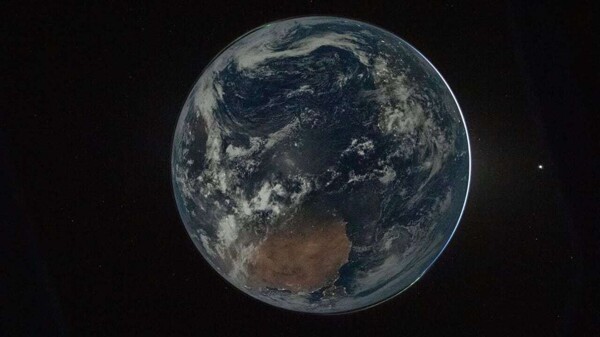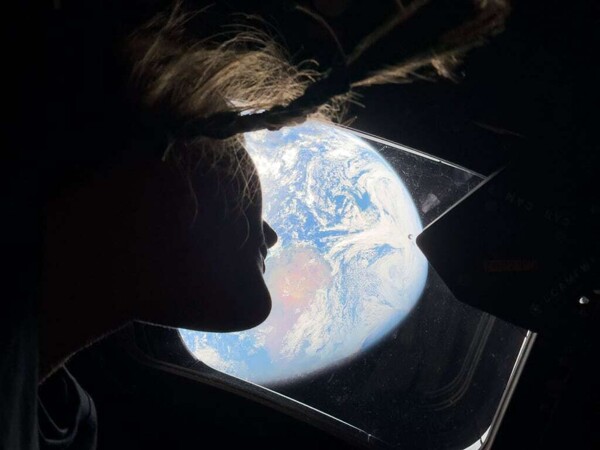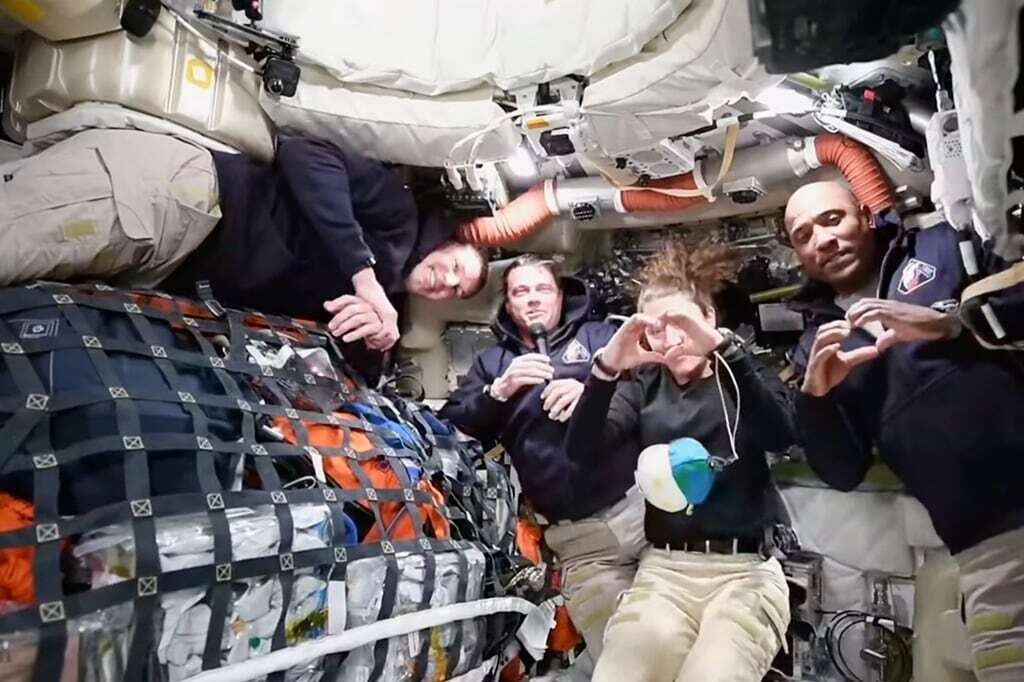
The Artemis II mission is not only changing the human view of the Moon but is also renewing the image of the Earth. In the photo titled 'Hello, World,' taken by Commander Reid Wiseman after the translunar injection maneuver, NASA identified two auroras—one in the upper right and another in the lower left—as well as zodiacal light visible as the Earth eclipses the Sun. The agency defined it as one of the first images transmitted by the crew and one of the most striking at the start of the mission. This image offers a lesson on how the Earth looks from deep space, with the night side visible, a thin atmosphere outlining the contour, and phenomena like auroras and the faint glow of interplanetary dust. NASA also shared a series of photos from inside Orion showing the crew working in an almost-dark cabin to avoid reflections on the windows, while Canadian Jeremy Hansen and the rest of the team continue to observe the Earth and prepare for the decisive phase of the mission. By the close of this stage, Artemis II has already confirmed several important things. First, the mission successfully maintains its trajectory toward the Moon with planned corrections and without deviating from its main objective. Second, the crew is operating normally in deep space after NASA reported that in these first days, they practiced medical procedures, tested Orion's emergency communications system, and prepared the cabin for the lunar flyby. Third, human observations have regained a unique weight in exploration, as they do not replace robotic cameras but do bring context, perception, and emotion to lunar science. The whole world is marveling at the first results of the Artemis II mission, which has already begun to deliver images that seem like science fiction but are completely real. Halfway to the Moon, the NASA crew captured photos of the Moon and Earth that are not only spectacular but also have scientific and historical value. One of the images allows one to see the Orientale basin on the edge of the lunar disk, a special event because, according to NASA, it is the first time the entire basin has been seen by human eyes. The Orientale basin, according to the Lunar and Planetary Institute (LPI), is one of the best examples of an impact on the Moon, with well-preserved mountain rings and a structure that reveals how these giant impacts formed in the satellite's early history. Its relative lack of flooding by basalts makes it especially valuable for studying lunar geology. And now, the complete view from the crewed spacecraft allows human exploration a perspective that only robotic cameras have had until now. As of this moment, except for an incident with the toilet, the crew's trajectory is proceeding successfully, so it is projected that on April 6, the spacecraft will perform its expected lunar flyby. NASA explains that this Monday will be the day when Orion enters the zone of maximum visual and scientific proximity with the satellite before orbiting it and continuing its journey back to Earth. According to reports, the spacecraft entered the lunar sphere of influence on April 5, the point where the Moon's gravity surpasses the Earth's over Orion, a key step before Monday's encounter. That is why the anticipation is so high, as it will be the first time in over half a century that a human crew has looked so closely at the Moon from a spacecraft about to orbit it. The agency set the window for this historic moment between 2:45 PM and 9:40 PM EDT on this Monday, which is equivalent to 1:45 PM to 8:40 PM in Austin, Texas. NASA announced that this will be the period during which the crew will be close enough to make direct scientific observations of the Moon with Orion's windows oriented toward it. This flyby is not just a scenic tour; according to the official mission schedule, on flight day 6, the astronauts will carry out specific tasks of observation, photography, and documentation of the lunar surface, in addition to entering one of the most symbolic phases of the journey: the passage around the far side. The Canadian Space Agency also explained that this flight makes Jeremy Hansen the first Canadian and the first non-American on a mission around the Moon, adding another historical layer to Monday's events. Jeremy Hansen of the Canadian Space Agency (CSA) is a mission specialist, meaning he has trained for all roles to jump into action wherever needed.