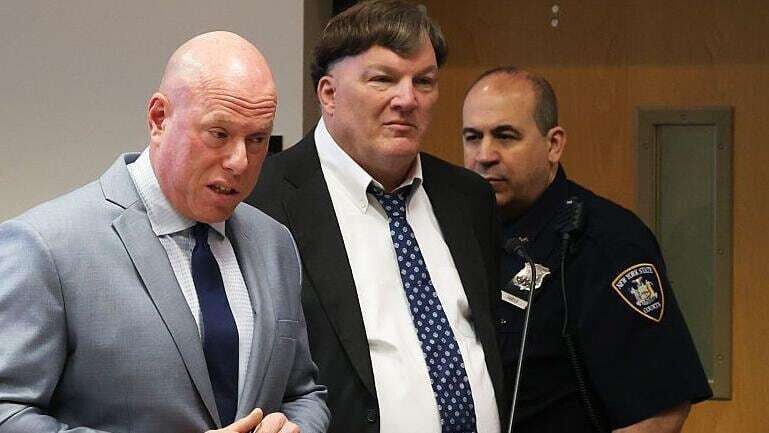
The night before the hearing where his statement was expected, the house was once again filled with reporters, while his ex-wife, Ellerup, and their children spoke to the press alongside their lawyer, responding to a wrongful death lawsuit filed by a victim's relative. After Heuermann was imprisoned, his wife and two children remained in the house, even having barbecues on the front porch despite curious onlookers. But as Heuermann's statement hearing approached, the rest of the town was eager to put it all behind them. “Everyone had a theory.” Those theories ended in 2023 when police arrested Heuermann, a married father of two living in Massapequa Park, a quiet Long Island suburb, in a dilapidated house where he grew up. The 62-year-old architect was taken into custody by Suffolk County police, who raided his Manhattan office after linking him to the murders through DNA samples obtained from a pizza box. Heuermann was initially charged with the murders of seven women, but on Wednesday he pleaded guilty to an additional homicide that occurred in 1996. “You don't think about it.” Once considered a nuisance to the neighborhood, Heuermann's childhood home now draws media and true crime enthusiasts. A saga that lasted decades came to an end in a Suffolk County courtroom on Wednesday, when a 6-foot-3 man dressed in a black suit and blue tie stood before a judge and confessed the chilling details of the murders of eight women. Rex Heuermann remained expressionless as he confirmed to Judge Timothy Mazzei that he had strangled and bound each of them in the same way before leaving their remains on remote Long Island (New York) beaches. He answered “yes” to each of the judge's questions about his crimes, without looking into the courtroom filled with victims' families, some of whom were crying. The families of the women had waited more than a decade as investigators took years to solve the murders that had terrorized many Long Island residents. “A lot of people talked about it; it wasn't a taboo subject,” Sandra Symon, a high school classmate of Heuermann, told the BBC. “American society has little memory for things.” “I know who my neighbors are here, but you really don't know anyone, to be honest.” A confession after years of silence Although Heuermann's guilty plea on Wednesday brought some relief to the families and friends of the women, many say it should have happened years ago. Police investigated the deaths for over a decade and held onto a lead that—once followed by investigators—led to the killer in a matter of weeks. The victims' families have alleged that the police did not try hard enough because the women murdered were sex workers, citing the frequent emphasis by agents on referring to them as “prostitutes.” Some Long Island residents agreed with this opinion, saying they were horrified by how long it took to get justice. “They are not worth any less for what they had to do,” declared Ellen Munoz, a resident of a nearby town who attended Heuermann's hearing. The Suffolk County Police Department did not involve federal investigators in the investigation at the outset, and the leaders of the probe faced separate scandals. He spoke few words besides “strangulation” when asked how he killed them, and “guilty” when asked to formally enter his new pleas. “There wasn't a shred of remorse on that man's face,” said John Ray, an attorney for the victims' families, after the hearing. Residents told the BBC that, apart from the occasional headline, they no longer think about the serial killer who once lived among them. “It's not news anymore,” said Joe. after killing numerous women “I spent 30 years working as a therapist for killers and concluded that no one is born bad” From there, they analyzed the disposable phones used to contact the victims; cell tower data; and hairs found on the victims' bodies that matched the DNA found in the pizza remains he had thrown out. In his basement, police found more evidence, including manuals he had written himself on his computer about how to carry out the murders. From there, they analyzed the disposable phones used to contact the victims; cell tower data; and hairs found on the victims' bodies that matched the DNA found in the pizza remains he had thrown out. In his basement, police found more evidence, including manuals he had written himself on his computer about how to carry out the murders. Although many of his victims had been missing for years, the case came to light in 2010 when investigators found the remains of four bodies within a half-mile radius on Gilgo Beach. After initially pleading not guilty, Heuermann eventually admitted to the murders of Melissa Barthelemy, 24; Megan Waterman, 22; Amber Costello, 27; Maureen Brainard-Barnes, 25; Jessica Taylor, 20; Valerie Mack, 24; Sandra Costilla, 28; and Karen Vergata, 34. All of Heuermann's victims are believed to have been sex workers at the time of their deaths, some of them contacted by him through his ads on the Craigslist page. On Wednesday, Heuermann offered few new details about the murders in court; he simply confirmed to the judge that he lured them with the promise of money and then killed and dismembered them before leaving their remains on the beach. The former police chief James Burke, who oversaw the case, was arrested in 2015 and later convicted on charges that included obstruction of justice. “He was as cold as ice.” He received several life sentences, which will be formally imposed on June 17. During the brief hearing, his ex-wife, Asa Ellerup, watched from the back of the courtroom, expressionless and dressed in black, alongside their daughter, who held tissues in her hand. Outside the courtroom, Ellerup said her thoughts were with the victims' families and called their loss “immeasurable.” “You don't know anyone”: a neighborhood confronts the reality of a killer In the small town of Massapequa Park on Long Island, home to 18,000 people, American flags line streets surrounded by dozens of well-kept homes, some with boats parked in the driveway. But for many in the neighborhood, there was always one house that stood out: the dilapidated house with red shutters and green-trimmed windows, located just one block from Joe, who moved to the neighborhood with his then-wife in 1995. “It doesn't fit in with the neighborhood, but what are you going to do?” said Joe, who preferred not to share his last name for privacy reasons. The case also led to the downfall of Thomas Spota, the Suffolk County district attorney from 2002 to 2017, who also led the Gilgo Beach investigation. In 2022, with new leadership, the Suffolk County Police formed a special task force to investigate the murders—incorporating federal and local law enforcement—which led them to Heuermann in six weeks. Police acted on a description of a suspect provided by the companion of one of the victims, Amber Costello, in 2010 after she had a run-in with a client. The new victim of serial killer Ted Bundy who was identified 51 years after her death Rodney Alcala, the serial killer who appeared on a US TV dating show.