Washington/Caribbean, December 1, 2025 – Total News Agency-TNA. The warnings of retired Admiral James Stavridis, former Supreme Allied Commander of NATO, have set off new alarms over the depth and strategic significance of the growing U.S. military deployment off the coast of Venezuela.
The analysis aligns with recent diplomatic efforts whose goal would be to force a negotiated resignation that avoids a high-cost military clash. For Washington, insisted the former commander, Venezuelan drug trafficking already constitutes “an act of war,” and when that category appears in U.S. doctrine, “the ‘if’ disappears; only the ‘when’ remains.”
“Each step opens the door to the next,” he explained, emphasizing that in this type of operation, escalatory logic rarely stops once initiated.
Stavridis emphasized that Nicolás Maduro still has a “narrow but real” exit: accept a deal and leave the country before a kinetic phase is activated.
“It is a force of strategic coercion,” he warned, dismantling the official Caracas version that seeks to present the operation as a simple antidrug action.
The analogy suggests that the White House is sending an unequivocal message to Caracas amid an unprecedented deployment in the Caribbean. The former allied commander specified that the region has ceased to be a political board and has become one strictly military.
“That is not an interdiction force. Or to change regimes,” he stated.
On President Trump's table, —as enumerated by Stavridis— there is a staggered menu of military options: surgical strikes against drug trafficking structures; attacks on critical infrastructure; suppression of air defenses; direct blows to military leadership; and, in the extreme, a Marine landing.
“A quiet plane, a silent landing in Moscow or Havana, and the world will keep turning. But if the missiles launch, that door closes forever,” he maintained.
“A deployment like this doesn't move to chase speedboats: it moves to change decisions at the highest level.”
In his reading, Maduro can still avoid the storm, “but only if he moves now.” Meanwhile, tension is growing in the Caribbean and in regional capitals, diplomatic and military consultations are multiplying in the face of a scenario that, according to defense sources consulted, is rapidly evolving towards a point of no return.
According to Stavridis, far from being a routine warning, the White House message is an ultimatum: “Take the deal and leave. After this, there will be no more negotiation.”
His statements, formulated with the analytical coldness characteristic of high command, reflect that the U.S. president's order to “close” Venezuelan airspace is far from a protocolary gesture: it constitutes, he said, “a strategic order” and an indication that the military scenario is entering a critical phase.
Stavridis recalled that in previous operations —Kosovo, Libya, Syria— the same pattern preceded direct actions: first, the warning to protect civil aviation; then, the silent phase in which “the Tomahawks fly at sea level.”
With Venezuelan airspace declared “closed” to civil aviation by direct order from Washington, the hemisphere observes an unmistakable signal: the phase of warnings may be coming to an end.
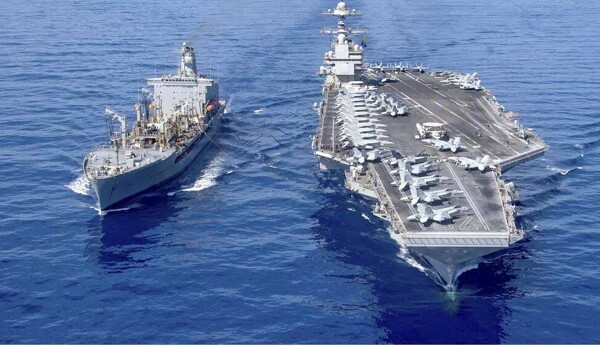
“The final warning was the most forceful: ‘When a Ford-class aircraft carrier parks off your coast, the clock does not run in your favor; it runs against you.’”
For the military, history shows that when the United States deploys forces “too large for a mission too small,” it is not showing muscle, but preparing a transition.
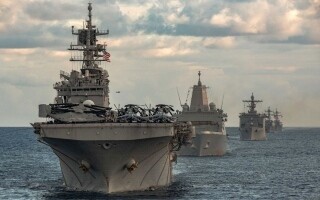
Currently, the United States maintains more than a dozen warships, several thousand Marines, and a Ford-class aircraft carrier —the world's most advanced naval platform— off the coast of Venezuela.