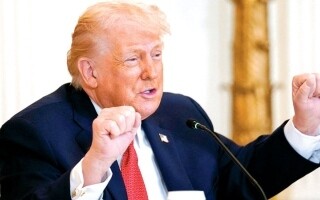
Talks between officials from the United States, Denmark, and Greenland have revealed a significant gap that cannot be closed between the ambitions of U.S. President Donald Trump to seize the island and respect for the sovereignty of nations. Trump currently claims that the United States needs Greenland to support the 'Golden Dome' initiative for missile defense, during which European leaders are currently sending small numbers of military troops to Greenland. U.S. Vice President J.D. Vance and Secretary of State Marco Rubio met with Danish Foreign Minister Lars Løkke Rasmussen and Greenlandic Foreign Minister Vivian Motfeldt in an attempt to find common ground to exit the crisis, which is now being called 'surreal.' Rasmussen told reporters: 'There is a fundamental disagreement,' adding that he was unable to change Trump's position. He continued: 'It is clear that Trump has this desire to seize Greenland.' Vivian Motfeldt reiterated her firm stance, saying: 'Greenland refuses to be owned or ruled by any entity, or to be part of the United States.' The meeting, which took place a week after Trump's threats escalated, was intended to ease tensions, but President Trump remains insistent on his plan to annex Greenland. While both sides agreed to form a 'high-level working group' to continue negotiations, it seems this is merely a stalling tactic, as Trump continues to insist that Greenland must be 'under the control of the United States, and anything less than that is unacceptable.' 'Golden Dome'After the collapse of the narrative about 'Russian and Chinese ships being off the coast of the island,' the White House is focusing on a new story: the 'Golden Dome.' Trump is currently focusing on the claim that full control of Greenland is 'vital' for the proposed multi-layered missile defense system, designed to intercept hypersonic and ballistic threats. U.S. Vice President J.D. Vance bolstered this position by saying: 'All the necessary infrastructure for missile defense partially depends on Greenland.' Despite the island's undeniable strategic value, U.S. Space Forces already operate the 'Pituffik' Space Base with full radar coverage. Experts reject Trump's claim that annexing the island is necessary for the 'Golden Dome,' arguing that existing agreements, particularly the 1951 'Greenland Defense Agreement,' currently allow for the expansion of the project and any necessary updates on the island. It appears the 'Golden Dome' argument is nothing more than a bureaucratic cover for an ideological desire to expand its sphere of influence. Danish Foreign Minister Lars Løkke Rasmussen pointed out that there is no evidence of Russian or Chinese interest in colonizing the island, rendering the U.S. administration's argument invalid. Buying GreenlandThe U.S. Secretary of State, Marco Rubio, was tasked with presenting a proposal to buy Greenland for $700 billion. While military threats are just rhetoric to pressure Denmark, the financial offer is presented as 'serious.' Danish Foreign Minister Rasmussen firmly rejected the idea, sharply criticizing the American social model, saying: 'The United States cannot under any circumstances afford the cost of a Scandinavian or Greenlandic social welfare system.' Greenland's response was just as firm as Rasmussen's. Greenland's Prime Minister, Jens-Frederik Nielsen, stated last Tuesday: 'We choose Denmark, we choose NATO, the Kingdom of Denmark, and the European Union.' It seems Nielsen, 34, is walking a tight rope: as a business-friendly leader, he wants American investment but refuses to treat Greenland as a prize to be snatched. A Divide in CongressThe crisis has spread to Congress. In the right-wing, pro-expansion faction, Senator Randy Feeney, a Republican from Florida, has laid out a legal framework to recognize Greenland as the 51st U.S. state. Feeney stated: 'Greenland is not some remote corner we can ignore; it is a vital resource for national security.' In response, U.S. Representative Jimmy Gomez, a Democrat from California, introduced the 'Greenland Sovereignty Protection Act,' aimed at preventing the use of federal funds 'to invade, annex, purchase, or otherwise seize the island.' The bill prohibits funding increased troop levels or influence campaigns aimed at shaping public opinion in Greenland. Republicans do not agree on this position. Representative Thomas Massie, a Republican from Kentucky, joked: 'Tell this administration that the Epstein files are in Greenland, they'll lose all interest in it.' Senator Lisa Murkowski, a Republican from Alaska, Senator Ruben Gallego, a Democrat from Arizona, Representative Ro Khanna, a Democrat from California, and Representative Don Bacon, a Republican from Nebraska, have introduced a 'Sense of Congress' bill that affirms U.S. partnership with Denmark and Greenland and recognizes America's responsibility to honor its treaty obligations and resolve any disputes peacefully. Europe's PositionMeanwhile, the Danish government has stated that Danish soldiers will open fire in response to any invasion of the island. Denmark allocated about $6.5 billion last year to bolster its military presence in the Arctic after Trump dismissed Danish defenses as 'two sleds.' The Danish Armed Forces and their European allies have announced an increased military presence in Greenland. A group of European countries has sent small symbolic forces to Greenland: Germany sent 13 soldiers as a reconnaissance team, France sent 15, Sweden sent a group of officers, while Norway, the Netherlands, and the UK sent a small number of individuals. The White House stated that the presence of European troops in Greenland will not change Trump's mind. The total number of these forces is around 30 soldiers, which of course pales in comparison to the 200 American soldiers already at the 'Pituffik' base—a U.S. space base on Greenland's northwest coast, not to mention any other U.S. reinforcements. However, the primary goal of these European forces is political. A French diplomat, who wished to remain unnamed, said: 'We will show the United States that NATO exists.' With European forces on the ground, any American incursion would be tantamount to an attack on Germany, France, and the UK all at once. The statements from European capitals sound 'catastrophic.' Danish Prime Minister Mette Frederiksen and EU Defense Commissioner Andrius Kubilius warned that any U.S. military action against a NATO member state would lead to the end of the alliance. Polish Prime Minister Donald Tusk went even further, stating that such an attack would be 'the end of the world as we know it.' A Diplomatic DeadlockThe 'high-level working group' will meet in Copenhagen next month, but expectations are low. It appears the U.S. administration is determined to proceed with the annexation despite the diplomatic deadlock. There is a clear way out, but it requires the White House to acknowledge that sovereignty is not up for sale. The legitimate security concerns regarding the 'Golden Dome' can be addressed through the 1951 defense agreement, which has served U.S. interests for nearly 75 years. As for the vital minerals, the U.S. should seek to obtain them through diplomatic trade deals and joint projects that respect Greenland's high environmental standards. The handful of European soldiers currently stationed in Greenland will not stop any U.S. military action if Trump decides to attack, but their presence raises a question every American should ponder: how did we become the threat that our own allies need protection from?