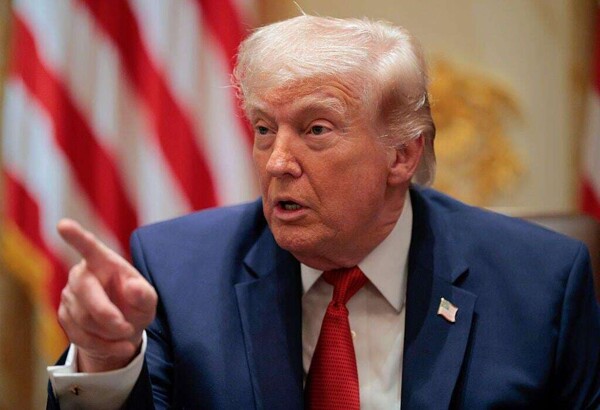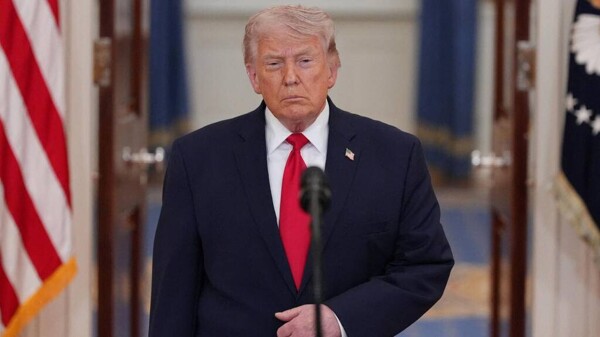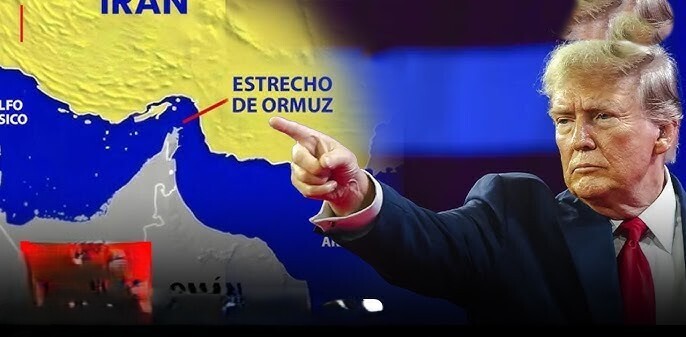
Donald Trump once again ratcheted up the war with Iran on Friday by assuring that the United States could easily reopen the Strait of Hormuz with “a little more time” and even “take the oil” and “make a fortune.” The statement, launched on his Truth Social, was not just a simple campaign boast: it fell in the middle of a global energy crisis, with disrupted markets, allied governments demanding a way out, and growing pressure on the White House to explain how it plans to unblock one of the planet's most sensitive maritime passages without pushing the region into an even greater escalation. And in a war where civilian infrastructure is already being hit, there are cross-border threats, pressure on Arab allies, and a world economy tied to every move in that maritime strip, Trump's words weigh almost as much as the missiles. That is, while Trump talks about opening the strait, taking the oil, and “making a fortune,” in his own country there is a growing perception that the bill for this adventure has already started to arrive at the gas pumps, in people's pockets, and in the social mood. The paradox is brutal. The conflict, thus, ceased to be a limited showdown to become a war of attrition over infrastructure, energy, and political nerves. In parallel, the great weakness of Trump's discourse remains the same: he promises he can open Hormuz, but he does not clearly explain how he would do it or at what military, diplomatic, or economic cost. Normally, about a fifth of the world's oil and gas consumption passes through Hormuz, so every high-flown statement from Washington immediately reverberates in prices, stock markets, and strategic calculations around the globe. Trump's new verbal outburst also came just hours after another episode that deepened the tension: the U.S. attack on the B1 bridge, a major road project under construction between Tehran and Karaj, which the president himself exhibited on social networks as a sign of strength and a warning that “much more will follow.” And in that vacuum, Trump seems to be acting more on impulse than on a closed diplomatic architecture. The economic impact of that uncertainty is already being strongly felt. Reuters reported that U.S. crude jumped more than 11% and that Brent rose nearly 8% following the president's new threats, while financial markets continue to oscillate between the fear of a long war and the increasingly faint hope of a negotiated exit. The president who presents himself as the man capable of restoring order in the Gulf is today, at the same time, one of the main factors fueling global volatility. While the United Kingdom brought together more than 40 countries to demand the reopening of the passage and support a coordinated pressure strategy on Iran, a resolution pushed by Bahrain to protect commercial navigation is advancing at the UN, although with strong objections from China, Russia, and also reservations from other actors about any authorization that smells of open armed intervention. The political message was transparent: the Republican administration not only wants to break Iran's ability to sustain the closure of Hormuz, but also to hit sensitive infrastructure to increase the internal cost of Tehran's challenge. That is why, rather than a solution, his promise to “easily” reopen the strait sounded this Friday like another chapter in a risky bet with an uncertain end and potentially enormous cost for the entire world. His speech may excite the hardest sectors of his base, but it does not yet offer a convincing roadmap to defuse the Hormuz knot without setting the region on fire even more. On the other side, the response was not long in coming. The Islamic Revolutionary Guard Corps promised “more crushing, broader, and destructive” attacks, while Iran continued to show it has no intention of backing down from intimidation and extended regional pressure with new blows to energy and water facilities in Kuwait, a key U.S. ally in the Gulf.