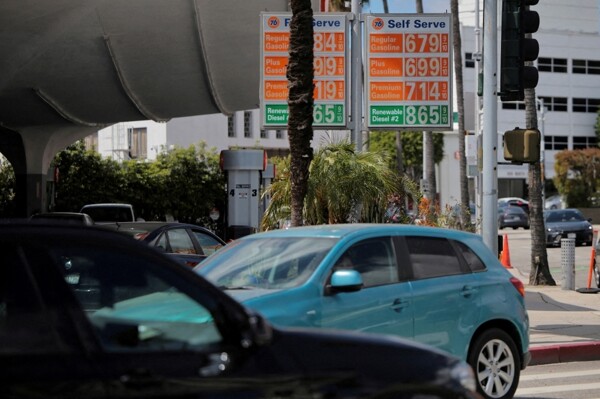
That's why the analyses coincide: even with the war ongoing, Democrats look better positioned to retake the House, while Republicans have a clearer path to retain the Senate. In that scenario, Republicans would likely lose the House and be on the defensive in the Senate. The third is the worst scenario—a prolonged war or a humiliating peace—would turn the problem into something bigger: it would no longer be about keeping both chambers, but about avoiding a defeat that would turn Trump's last two years into a congressional calvary of investigations, legislative gridlock, and paralysis. My impression is that at this point, the war in Iran is unlikely to give Republicans a new robust majority. This is compounded by Trump's approval rating falling to the 39-41% range in Reuters/Ipsos, New York Times, and Fox News polls, hit by rising fuel prices and growing opposition to the conflict. And the war is not reaching voters as a patriotic epic, but as a source of anxiety. The underlying question is whether the outcome of that conflict will be enough for Republicans to retain control of the House and the Senate. At this point in April, with seven months to go and a landscape that is clouding every week, the answer is uncomfortable for the White House: the conflict could help them a bit if it ends quickly and with the appearance of success, but it could also become the factor that costs them, at least, one of the two chambers, and perhaps both. Foreign policy rarely decides a midterm election in the United States on its own. The outcome in Iran probably won't decide on its own who controls the upper chamber, but it could define whether the Republican majority thins dangerously or enters a real danger zone. There is also a mechanism that can weigh as much as macroeconomic figures: the internal cohesion of Trumpism. The war not only pits Republicans against Democrats; it has produced the first visible fissures within the MAGA universe. In the worst case, it will accelerate a trend that was already forming: loss of the House and a much tighter fight for the Senate than the White House would like to admit. Because in the U.S., wars are judged on military maps, yes, but they are paid for at the gas pump, in the supermarket, and, ultimately, at the ballot box. The House is much more sensitive to national sentiment and the wallet; Republicans now control it by a slim margin, and Democrats need to flip very few seats to take it back. The Senate is another case: the electoral map forces Democrats to defend seats in states that Trump won in 2024—Maine, Ohio, North Carolina—while Republicans are defending more comfortable ground and could lose three or four seats without losing the majority. Trump may be about to rediscover that same lesson. The political ground was already slippery before any military result was measured. The generic Congressional vote shows a persistent Democratic lead of 5.4 points, 48% to 42% for Republicans, according to the RealClearPolitics average. Instead of political expansion, the conflict has widened skepticism. The effect, however, will not be symmetrical in both chambers. In that case, Republicans would retain the Senate comfortably and could mount a real fight for the House. But the clock is ticking against them: there are only seven months until the election, and the margin for that scenario to materialize narrows with each week of operations. The second—an ambiguous truce, without a clear victory and with fuel still expensive—is today the most probable and also the most corrosive. If that pattern repeats, the suburban voter who is no longer sure about Trump will hardly grant him the benefit of the doubt in November. And here it is convenient to outline three scenarios. The first would be a relatively quick peace, a visible drop in gasoline prices, and a victory narrative credible enough for the conflict to disappear from the electoral radar before summer. The president's party usually loses ground in midterm elections, and even a clear military victory can evaporate if inflation, expensive gas, and economic malaise prevail at home. George H. W. Bush learned this after the Gulf War: an approval rating above 80% evaporated in less than a year when the recession entered the public conversation. They are still minority voices, but their appearance matters: when a war stops uniting and starts dividing the ruling coalition, it transforms from an electoral asset into a political tax. The outcome is as important as the duration. The relevant question for November 2026 is not just whether Donald Trump will be able to sell the war with Iran as a victory. It resembles the slow wear that Iraq inflicted on Republicans in 2006: it was not a spectacular defeat, but the accumulation of fatigue, distrust, and revulsion. Senator John Curtis and Representative Nancy Mace have publicly demanded that Trump seek congressional authorization if operations continue, breaking the line of loyalty that until recently seemed unconditional. It is not a death sentence, but it is an unequivocal sign of the climate. In the best case, it will limit the damage. Pew Center, Quinnipiac, and Economist/YouGov polls agree: between 54% and 61% of Americans oppose military operations, and 61% disapprove of the presidential handling of the Iranian issue (Pew Research, April 2026).