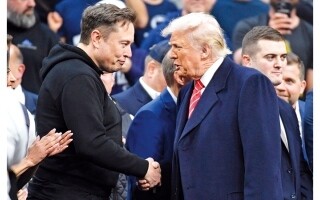
The waters have returned to their course, as the saying goes, between U.S. President Donald Trump and billionaire Elon Musk, after Musk was hosted by the president for two days at events held at the White House. Finally, Trump mentioned Musk by name in a speech he delivered the day before yesterday, following quiet diplomacy from Trump's advisors to repair one of the worst ruptures in political history.
Vice President J.D. Vance and White House Chief of Staff Susie Wiles played a crucial role in resolving the dispute and ensuring Musk's return to the president's inner circle, according to multiple sources inside or close to the White House. A source close to The Washington Post said: "Both Wiles and Vance assured Elon that he has an open line to the president and that they are willing and able to be his voice and honest intermediaries in any area where Elon wants to support the administration." The source added: "He has a special place to express that, this is a fundamental part of the deal, and however it's achieved, it won't become public, because the only thing they all value and have is the mutual trust to be able to speak privately and frankly, and this is what allowed this development to happen."
Meanwhile, Musk had shown some interest in making sure people know he wants to be supportive and cooperative, according to the same sources. An informed White House source stated that "the relationship has indeed improved" after more than five months since Musk's sudden call to oust Trump and his pledge to form a third party that could cost Republicans votes in next year's midterm elections.
Wiles expressed her appreciation for Musk because he "had a huge impact on our efforts to shrink government" as an "unpaid leader" of the Department of Government Efficiency from January to May, and "didn't want to lose that entirely," according to a second source. A third source reported that "Elon trusts Susie Wiles and the Vice President more than anyone else" and that Vance "is working to ease tensions."
The quiet talks bore fruit when Trump and Musk met face-to-face at the funeral of Charlie Kirk, co-founder of Turning Point USA, who was assassinated on September 21st in Arizona.
The main reason for the fallout was that Trump's long-time advisor, social media expert, and new Director of Presidential Personnel Dan Scavino, worked to reverse his predecessor Sergio Gor's decision to withdraw Jared Isaacson's nomination to lead NASA, which had been a primary source of Musk's anger. One source told the New York Post: "Dan saw correcting this mistake as his life's mission" and re-nominated Isaacson, a former astronaut.
Gor was farewelled in the Oval Office on November 10th before departing for India to serve as an ambassador, which critics saw as a soft landing after jeopardizing Trump's political agenda due to personal grievances.
Trump's relationship with Musk, who pumped $290 million into Republican campaigns last year to boost Trump's return, is notable given the depth of their sharp clash.
A stunning escalation occurred on June 5th, when U.S. President Donald Trump threatened to halt federal funding to Musk's SpaceX and Tesla companies. Musk claimed the president was involved in matters related to Jeffrey Epstein, who was embroiled in a sex scandal. After a period of de-escalation, including the deletion of posts about Epstein, Musk announced on July 5th that he would form a third party called "The Party of America" to "restore freedom" to Americans, which threatened to siphon votes from Republicans. A White House source said: "It took some time to cool things down, and Susie Wiles was able to do it," adding: "The truth is, Wiles's role has always been that of a behind-the-scenes operator, where she identifies problems and tries to solve them. Wiles has always played a role in patching up relationships where there was a mutual interest, and both Wiles and J.D. Vance made Elon comfortable coming directly to them when he had something he wanted to discuss."